J9CQSEC800QSec 800 Dual Mode Secure Cellular Phone
Qualcomm Technologies, Inc.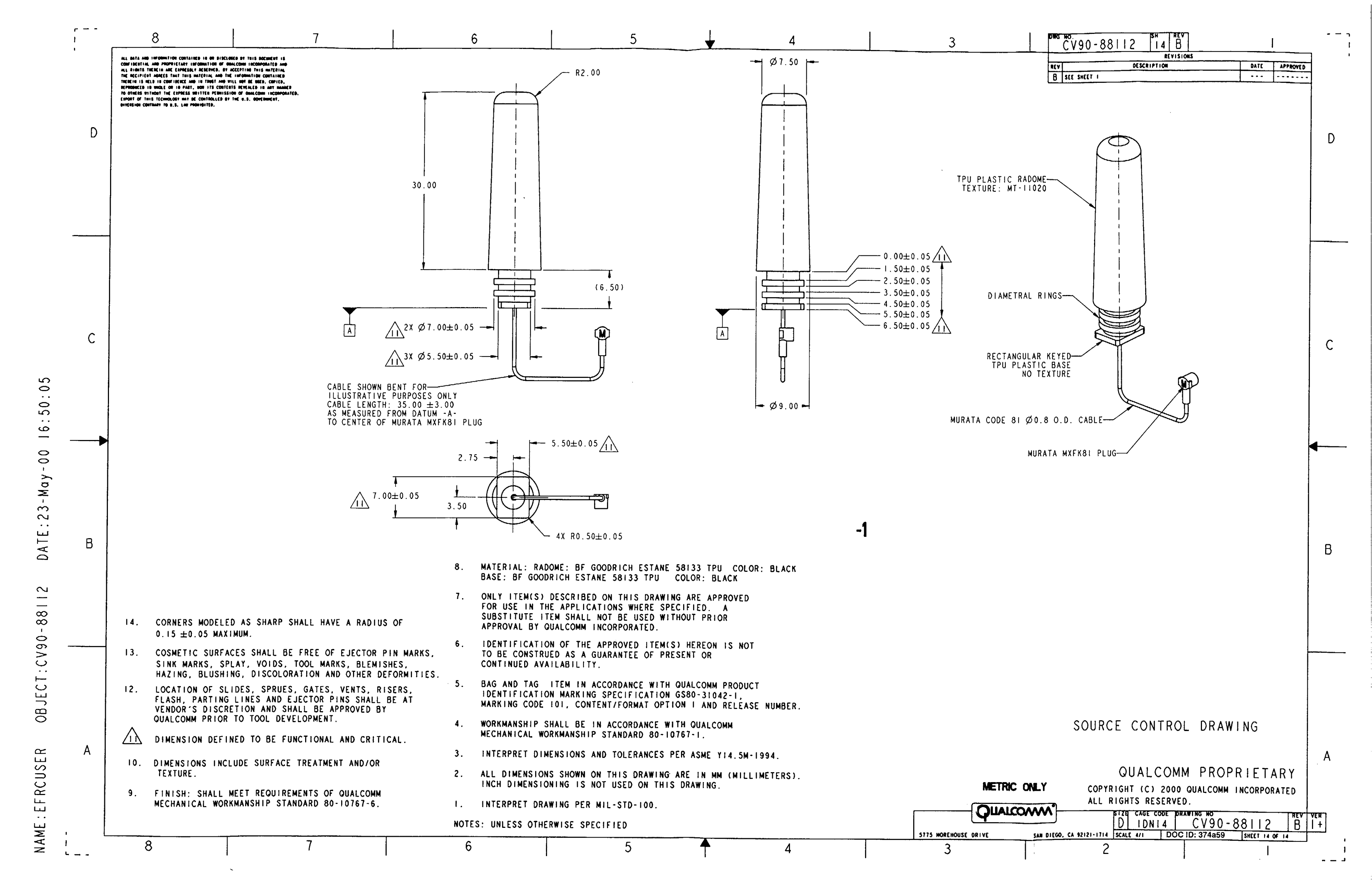
Click to zoom
Application Details
- Equipment Class
- TNE - Licensed Non-Broadcast Transmitter Held to Ear
- Date of Grant
- Jan 23, 2001
- Application Purpose
- Original Equipment
- Date of Application
- Jul 05, 2000
- Equipment Note
- QSec 800 Dual Mode Secure Cellular Phone
- Frequency Range
- 824.02000000 - 848.98000000
- Company
- Qualcomm Technologies, Inc.
- Country
- United States
Documents & Files
Document Text
Text extracted from the exhibit documents filed with the FCC. Open a document above to read the original.
Users Manual
Preliminary DraftDO NOT COPY QSec™-800 User Guide C QSEC-800 APR 25, TUE MENU BOOK D Preliminary DraftDO NOT COPY This user guide is based on the alpha version of the QSec™-800 telephone. Software changes may have occurred after this printing. QUALCOMM reserves the right to make changes in technical and product specifications without prior notice. The products and equipment described in this documentation are manufactured under one or more of the following U.S. Patents: 4,901,307,5,056,109,5,099,204,5,101,501,5,103,459,5,107,225, 5,109,390,5,193,094,5,228,054,5,257,283,5,265,119,5,267,261, 5,267,262,5,280,472,5,283,536,5,289,527,5,207,405,5,309,474, 5,337,338,5,339,046,5,341,456,5,383,219,5,392,287,5,396,516, D356,560,5,408,697,5,414,728,5,414,796,5,416,797,5,426,392, 5,437,055,D361,065,5,442,322,5,442,627,5,452,473,5,461,639, 5,469,115,5,469,471,5,471,497,5,475,870,5,479,475,5,483,696, 5,485,486,4,487,175,5,490,165,5,497,395,5,499,280,5,504,773, 5,506,865,5,509,015,5,509,035,5,511,067,5,511,073,5,513,176, 5,515,177,5,517,323,5,519,761,5,528,593,5,530,928,5,533,011, 5,535,239,5,539,531,5,544,196,5,544,223,5,546,459,5,548,812, 5,559,881,5,559,865,5,561,618,5,564,083,5,566,000,5,566,206, 5,566,357,5,568,483,5,574,773,5,574,987,D375,740,5,576,662, 5,577,022,5,577,265,D375,937,5,588,043,D376,804,5,589,756, 5,590,069,5,590,406,5,590,408,5,592,548,5,594,718,5,596,570, 5,600,754,5,602,834,5,602,833,5,603,096,5,604,730,5,604,459, 5,604,730,5,608,722,5,614,806,5,617,060,5,621,752,5,621,784, 5,621,853,5,625,876,5,627,857,5,629,955,5,629,975,5,638,412, 5,640,414,5,642,398,5,644,591,5,644,597,5,646,991,5,652,814, 5,656,979,5,655,229,5,657,420,5,659,569,5,663,807. Other patents pending. FCC/IC Notice This device complies with part 15 of the FCC rules. Operation is subject to the following two conditions: (1) This device may not cause harmful interference, and (2) this device must accept any interference received, including interference that may cause undesired operation. Caution The user is cautioned that changes or modifications not expressly approved by the party responsible for compliance could void the warranty and user’s authority to operate the equipment. Warning Use only QUALCOMM-approved accessories with QUALCOMM phones. Use of any unauthorized accessories may be dangerous and will invalidate the phone warranty if said accessories cause damage or a defect to the phone. Customer Service Your service provider’s customer support department should be able to answer all of your questions. If they are unable to assist you, please call (800) 349-4478 toll free (United States and Canada) or (619) 651-4028 (worldwide) QUALCOMM is a registered trademark and registered service mark and Smart Keys and QSec are trademarks of QUALCOMM Incorporated. All other trademarks and registered trademarks are the property of their respective owners. Copyright © 2000 QUALCOMM Incorporated. All rights reserved. Printed in the United States of America. 80-88240-1, Unreleased Preliminary Draft DO NOT COPYPreliminary Draft Preliminary DraftDO NOT COPY Preliminary DraftDO NOT COPYv Contents Before Using Your Phone ................................................................. 9 About your QSec™-800 .............................................................. 9 What’s in your package .............................................................. 9 Charging the battery .......................................................... 10 Getting help ................................................................................ 10 Your service provider ............................................................... 11 What’s in this guide .................................................................. 11 Conventions used in this book ................................................ 12 Getting to Know Your Phone ........................................................ 14 Turning your phone on and off ............................................... 16 To turn the phone on ......................................................... 16 To turn the phone off ......................................................... 16 Using the Push-to-Talk/Push-to-Unmute button ................ 17 Understanding display screens ............................................... 18 To navigate screens ............................................................ 18 To use Smart Keys™ .......................................................... 19 To choose options from screens ....................................... 20 To recognize your Home or Standby screen .................. 20 To return to Home screen ................................................. 21 To go back a screen ............................................................ 21 To use Help ......................................................................... 22 Understanding menus .............................................................. 22 To make menu selections .................................................. 23 To recognize submenus ..................................................... 24 To use Menu shortcuts ...................................................... 24 Menu tree and shortcuts ................................................... 25 Making and Receiving Calls ......................................................... 27 Before making calls ................................................................... 27 Know what kind of phone you have ............................... 27 Know your PIN .................................................................. 28 Making calls ............................................................................... 28 Direct dialing ...................................................................... 28 About making secure calls—secure “call setup” ..... 29 Redialing calls ..................................................................... 30 To redial the last number you dialed ........................ 30 To redial from the hi…
Text truncated - open the document above for the full version.
Attestation Statements
Applicant: QUALCOMM INC.FCC ID: J9CQSEC800 2 Certification of Test Data 2.911 The data, data evaluation and equipment configuration represented herein are a true and accurate representation of the measurements of the sample’s radio frequency interference emissions characteristics as of the dates and at the times of the test under the conditions herein specified. This applies to all tests that where performed that did not require an Open Area Test Site (OATS). Tests that required an OATS site were performed by TUV Product Services. Equipment Tested: QSEC 800 Dates of Test:June 14 – June 24 1999 Test Performed by: Engineer:John A. Forrester, __________________
Attestation Statements
Applicant: QUALCOMM INC.FCC ID: J9CQSEC800 3 FCC Letter of Site Recognition The FCC letter of Site Recognition is Included in the radiated spurious emissions data found in Exhibit 9: Radiated Spurious Emissions 2.1053
Attestation Statements
Applicant: QUALCOMM INC.FCC ID: J9CQSEC800 4 ESN Protection 22.919 The Cellular Portable Phone, FCC ID: J9CQSEC800 uses a ESN. The ESN is a unique identification number to each phone which is contained in the Numeric Assignment Module and is automatically transmitted to the base station whenever a cellular call is placed. The ESN is stored in an EPROM and is isolated from fraudulent contact and tampering. Any attempt to change the ESN will render the portable phone inoperative. The phone complies with all requirements for ESN under Part 22.919.
Attestation Statements
This document was generated in response to a request from Frank Coperich for additional technical information in regards to the Part22 type approval of the QSec 800 (fcc ID: J9CQSEC800). This document includes the email received by Mr. Coperich and the response to each question. Email received July 26, 2000: Date: Wed, 26 Jul 2000 11:10:09 -0400 From: [email protected] (OET) To: jforrester Subject: To:John Forrester, Qualcomm Incorporated From:Frank Coperich [email protected] FCC Application Processing Branch Re:FCC ID J9CQSEC800 Applicant:Qualcomm Incorporated Correspondence Reference Number:15275 731 Confirmation Number:EA98117 Date of Original E-Mail:07/26/2000 1.) Please submit evidence of compliance with the E-911 requirements under Section 22.921 of the Commission's R&R. 2.) Please submit a measurement of ERP for operation in the AMPs. mode. Normally this is done with the substitution method. If we convert the field strength reading of 125.4 dBuV/M listed in your radiated emissions test, the ERP value is greater than the .6 W specification for a Class III unit and different from the .398 W requested.. 3.) Please submit a measurement of ERP for operation in the CDMA mode. Normally this is done with the substitution method. If we convert the field strength reading of 124 dBuV/M listed in your radiated emissions test, the ERP is about .49 W and different from the .251 W value requested. The items indicated above must be submitted before processing can continue on the above referenced application. Failure to provide the requested information within 60 days of the original e-mail date may result in application dismissal pursuant to Section 2.917 (c) and forfeiture of the filing fee pursuant to section 1.1108. DO NOT reply to this e-mail by using the Reply button. In order for your response to be processed expeditiously, you must upload your response via the Internet at www.fcc.gov, Electronic Filing, OET Equipment Authorization Electronic Filing. If the response is submitted through Add Attachments, in order to expedite processing, a message which informs the processing staff that a new exhibit has been submitted must also be submitted via Submit Correspondence. Also, please note that partial responses increase processing time and should not be submitted. Any questions about the content of this correspondence should be directed to the e-mail address listed below the name of the sender. Responses: Question: 1) Please submit evidence of compliance with the E-911 requirements under Section 22.921 of the Commission's R&R. Response: The Qsec 800 meets the requirements of 22.921 by using the “Adequate/Strongest Signal” method approved by the Commission. The system software recognizes when a “911” call is made and overrides programming for “non-911” calls. The phone will then scan the control channels for the preferred carrier, and will complete the ”911” call if a signal of at least –85dBm is detected. If the preferred carrier’s signal strength is lover then –85 dBm, the handset will attempt to complete the “911” call using a non-preferred carrier. Please see the attached letter of declaration of compliance with 22.921. Question: 2.) Please submit a measurement of ERP for operation in the AMPs. mode. Normally this is done with the substitution method. If we convert the field strength reading of 125.4 dBuV/M listed in your radiated emissions test, the ERP value is greater than the .6 W specification for a Class III unit and different from the .398 W requested. Response: The intention of the reported AMPs mode ERP measurement was to demonstrate the worst case radiated spurious emissions profile of the QSec 800. The QSec 800 was configured to transmit at a power level where the phone’s power amplifier was operating close to its point of saturation. The transmitter generated harmonics and other related emissions were thus measured at their maximum possible levels. These measurements represent an output power level the QSec 800 is not designed to operate at. A production QSec 800 is calibrated to operate with a radiated ERP value of 0.398 Watts. At this power level, the spurious emissions will never exceed the values in the submitted measurements. Based on this test methodology, additional testing of the QSec 800 at a lower transmit power level of 0.398 watts is extraneous since the phone has already demonstrated compliance to Part 22 radiated emissions requirements at a higher transmit power level then requested for the type acceptance grant. If you feel the additional test data is absolutely required, the unit can be re-tested at the lower power level. Question: 3.) Please submit a measurement of ERP for operation in the CDMA mode. Normally this is done with the substitution method. If we convert the field strength reading of 124 dBuV/M listed in your radiated emissions test, the ERP is about .49 W and different from the .251 W value requested. Response: The intention of the reported CDMA mode ERP measurement was to demonstrate the worst case radiated spurious emissions profile of the QSec 800. The QSec 800 was configured to transmit at a power level where the phone’s power amplifier was operating close to its point of saturation. The transmitter generated harmonics and other related emissions were thus measured at their maximum possible levels. These measurements represent an output power level the QSec 800 is not designed to operate at. A production QSec 800 is calibrated to operate with a radiated ERP value of 0.251 Watts. At this power level, the spurious emissions will never exceed the values in the submitted measurements. Based on this test methodology, additional testing of the QSec 800 at a lower transmit power level of 0.251 watts is extraneous since the phone has already demonstrated compliance to Part 22 radiated emissions requirements at a higher transmit power level then requested for the type acceptance grant. If you feel the additional test data is absolutely required, the u…
Text truncated - open the document above for the full version.
Cover Letter(s)
Applicant: QUALCOMM INC.FCC ID: J9CQSEC800 LIST OF EXHIBITS ExhibitFCC ReferenceFCC File Name(s) 1General Information and Product Overview 2.1033 1.1 Grant Informationexhibit 1 general information.pdf 1.2 Addres of manufacturer and applicant2.1033 (c) (1)exhibit 1 general information.pdf 1.3 Technical Descriptionexhibit 1 general information.pdf 1.4 FCC Identifier 2.1033 (c) (2)exhibit 1 general information.pdf 1.5 User Manual 2.1033 (c) (3)exhibit 12 user guide.pdf 1.6 Types of Emissions 2.1033 (c) (4)exhibit 1 general information.pdf 1.7 Frequency Range 2.1033 (c) (5)exhibit 1 general information.pdf 1.8 Operating Power Levels 2.1033 (c) (6)exhibit 1 general information.pdf 1.9 Maximum Output Power 2.1033 (c) (7)exhibit 1 general information.pdf 1.1O DC Supply and Current Range2.1033 (c) (8)exhibit 1 general information.pdf 1.11 Limiting Modulationexhibit 1 general information.pdf 1.12 Power Limitingexhibit 1 general information.pdf 1.13 List of Semiconductor Active Devices 2.1033 (c) (10)exhibit 15 parts list.pdf 1.14 Circuit Diagram 2.1033 (c) (10)exhibit 14 schematics and parts.pdf 1.15 Transmitter Adjustment Procedureexhibit 1 general information.pdf 1.16 Frequency Stability Device 2.1033 (c) (10)exhibit 1 general information.pdf 1.17 Spurious Radiation Suppression Devices 2.1033 (c) (10)exhibit 1 general information.pdf 1.18 Drawing of Equipment Indentification Plate or Label 2.1033 (c) (11)exhibit 5 fcc id label.pdf 1.19 Photographs 2.1033 (c) (12)exhibit 16 mechanical drawings.pdf exhbit 17 antenna drawing.pdf exhibit 18 qsec800 photos.pdf 1.2O Modulation Techniques 2.1033 (c) (13)exhibit 1 general information.pdf 1.21 Test Data2.1033 (3) (14)exhibit 1 general information.pdf 1.22 RF Block Diagramexhibit 1 general information.pdf 2Certification of Test Data 2.911exhibit 2 certification data.pdf 3FCC Letter of Site Recognition exhibit 9 TUV radiated spurious.pdf 4ESN Protection 22.919exhibit 4 esn protection 5FCC Identification Label 2.1033 (c) (11)exhibit 5 fcc id label.pdf 6FM Conducted Test Data 2.1033 (c) (14)exhibit 6 fm conducted data.pdf 6.1 FM Transmitter Conducted RF Output Power 2.1046exhibit 6 fm conducted data.pdf 6.2 FM Transmitter Radiated RF Output Power 2.1046 22.913exhibit 6 fm conducted data.pdf 6.3 FM TOLAR Response 2.1047exhibit 6 fm conducted data.pdf 6.4 FM Audio Frequency Response 2.1047exhibit 6 fm conducted data.pdf 6.5 FM Modulation Limiting 2.1047 22.915exhibit 6 fm conducted data.pdf 6.6 FM Occupied Bandwidth 2.1049 22.915exhibit 6 fm conducted data.pdf 6.7 FM Conducted Spurious Emissions and Transmit Harmonics 2.1051 22.917exhibit 6 fm conducted data.pdf 7CDMA Conducted Emissions Data 2.1033 (c) (14)exhibit 7 cdma conducted data.pdf 7.1 CDMA Transmitter Conducted RF Output Power 2.1046exhibit 7 cdma conducted data.pdf 7.2 CDMA Transmitter Radiated RF Output Power 2.1046 22.913exhibit 7 cdma conducted data.pdf 7.3 CDMA Occupied Bandwidth 2.1049 22.917exhibit 7 cdma conducted data.pdf 7.4 CDMA Conducted Spurious Emissions and Transmit Harmonics 2.1051 22.917exhibit7 cdma conducted data.pdf 8Frequency Stability 2.1055exhibit 8 freq stability.pdf 9Radiated Spurious 2.1053exhibit 9 TUV radiated spurious.pdf 10Measurement Procedures and Techniques 2.1051exhibit 10 procedures.pdf 11SAR Report 2.1093, 1.1310exhibit 11a sar report.pdf exhibit 11b data-calibration info.pdf exhibit 11c sar system photos.pdf exhibit 11d sar head photos.pdf exhibit 11e sar waist photos.pdf exhibit 11f sar ptt photos.pdf 12User Guide 2.1033 (c) (3)exhibit 12 user guide.pdf 13RF Block Diagram exhibit 13 RF block diagram.pdf 14Schematics 2.1033 (c) (10)exhibit 14 schematics and parts.pdf 15Parts List 2.1033 (c) (10)exhibit 15 parts list.pdf 16Mechanical Drawings 2.1033 (c) (12)exhibit 16 mechanical drawings.pdf 17Antenna Drawings 2.1033 (c) (12)exhbit 17 antenna drawing.pdf 18Photographs 2.1033 (c) (12)exhibit 18 qsec800 photos.pdf
External Photos
Applicant: QUALCOMM INC.FCC ID: J9CQSEC800 17 Antenna Drawing 2.1033 (c) (12)
ID Label/Location Info
Applicant: QUALCOMM INC.FCC ID: J9CQSEC800 5 FCC Identification Label 2.1033 (c) (11) The identifier label is located on the back of the phone under the removable battery. FCC Label Actual Size FCC Label Enlarged
Operational Description
Applicant: QUALCOMM INC.FCC ID: J9CQSEC800 LIST OF EXHIBITS ExhibitFCC ReferenceFCC File Name(s) 1General Information and Product Overview 2.1033 1.1 Grant Informationexhibit 1 general information.pdf 1.2 Addres of manufacturer and applicant2.1033 (c) (1)exhibit 1 general information.pdf 1.3 Technical Descriptionexhibit 1 general information.pdf 1.4 FCC Identifier 2.1033 (c) (2)exhibit 1 general information.pdf 1.5 User Manual 2.1033 (c) (3)exhibit 12 user guide.pdf 1.6 Types of Emissions 2.1033 (c) (4)exhibit 1 general information.pdf 1.7 Frequency Range 2.1033 (c) (5)exhibit 1 general information.pdf 1.8 Operating Power Levels 2.1033 (c) (6)exhibit 1 general information.pdf 1.9 Maximum Output Power 2.1033 (c) (7)exhibit 1 general information.pdf 1.1O DC Supply and Current Range2.1033 (c) (8)exhibit 1 general information.pdf 1.11 Limiting Modulationexhibit 1 general information.pdf 1.12 Power Limitingexhibit 1 general information.pdf 1.13 List of Semiconductor Active Devices 2.1033 (c) (10)exhibit 15 parts list.pdf 1.14 Circuit Diagram 2.1033 (c) (10)exhibit 14 schematics and parts.pdf 1.15 Transmitter Adjustment Procedureexhibit 1 general information.pdf 1.16 Frequency Stability Device 2.1033 (c) (10)exhibit 1 general information.pdf 1.17 Spurious Radiation Suppression Devices 2.1033 (c) (10)exhibit 1 general information.pdf 1.18 Drawing of Equipment Indentification Plate or Label 2.1033 (c) (11)exhibit 5 fcc id label.pdf 1.19 Photographs 2.1033 (c) (12)exhibit 16 mechanical drawings.pdf exhbit 17 antenna drawing.pdf exhibit 18 qsec800 photos.pdf 1.2O Modulation Techniques 2.1033 (c) (13)exhibit 1 general information.pdf 1.21 Test Data2.1033 (3) (14)exhibit 1 general information.pdf 1.22 RF Block Diagramexhibit 1 general information.pdf 2Certification of Test Data 2.911exhibit 2 certification data.pdf 3FCC Letter of Site Recognition exhibit 9 TUV radiated spurious.pdf 4ESN Protection 22.919exhibit 4 esn protection 5FCC Identification Label 2.1033 (c) (11)exhibit 5 fcc id label.pdf 6FM Conducted Test Data 2.1033 (c) (14)exhibit 6 fm conducted data.pdf 6.1 FM Transmitter Conducted RF Output Power 2.1046exhibit 6 fm conducted data.pdf 6.2 FM Transmitter Radiated RF Output Power 2.1046 22.913exhibit 6 fm conducted data.pdf 6.3 FM TOLAR Response 2.1047exhibit 6 fm conducted data.pdf 6.4 FM Audio Frequency Response 2.1047exhibit 6 fm conducted data.pdf 6.5 FM Modulation Limiting 2.1047 22.915exhibit 6 fm conducted data.pdf 6.6 FM Occupied Bandwidth 2.1049 22.915exhibit 6 fm conducted data.pdf 6.7 FM Conducted Spurious Emissions and Transmit Harmonics 2.1051 22.917exhibit 6 fm conducted data.pdf 7CDMA Conducted Emissions Data 2.1033 (c) (14)exhibit 7 cdma conducted data.pdf 7.1 CDMA Transmitter Conducted RF Output Power 2.1046exhibit 7 cdma conducted data.pdf 7.2 CDMA Transmitter Radiated RF Output Power 2.1046 22.913exhibit 7 cdma conducted data.pdf 7.3 CDMA Occupied Bandwidth 2.1049 22.917exhibit 7 cdma conducted data.pdf 7.4 CDMA Conducted Spurious Emissions and Transmit Harmonics 2.1051 22.917exhibit7 cdma conducted data.pdf 8Frequency Stability 2.1055exhibit 8 freq stability.pdf 9Radiated Spurious 2.1053exhibit 9 TUV radiated spurious.pdf 10Measurement Procedures and Techniques 2.1051exhibit 10 procedures.pdf 11SAR Report 2.1093, 1.1310exhibit 11a sar report.pdf exhibit 11b data-calibration info.pdf exhibit 11c sar system photos.pdf exhibit 11d sar head photos.pdf exhibit 11e sar waist photos.pdf exhibit 11f sar ptt photos.pdf 12User Guide 2.1033 (c) (3)exhibit 12 user guide.pdf 13RF Block Diagram exhibit 13 RF block diagram.pdf 14Schematics 2.1033 (c) (10)exhibit 14 schematics and parts.pdf 15Parts List 2.1033 (c) (10)exhibit 15 parts list.pdf 16Mechanical Drawings 2.1033 (c) (12)exhibit 16 mechanical drawings.pdf 17Antenna Drawings 2.1033 (c) (12)exhbit 17 antenna drawing.pdf 18Photographs 2.1033 (c) (12)exhibit 18 qsec800 photos.pdf Applicant: QUALCOMM INC.FCC ID: J9CQSEC800 1 General Information and Product Overview 2.1033 1.1 Grant Information Power Information Conducted Power as Measured at Antenna Connector Radiated EIRPRadiated ERP dBmWattsdBmWattsdBmWatts FM Grant Power260.39828.20.66126.00.398 CDMA Grant Power240.25124.20.26324.00.251 FM SAR Power27.00.50129.20.83227.00.501 FCC Identification J9CQSEC800 Emissions Designators, Frequency range, and Output Power ModeEmissions DesignatorFrequency Range (MHz)ERP Output (Watts) FM AMPS40K0F8W824.02-848.980.398 FM AMPS40K0F1D824.02-848.980.398 CDMA1M25F9W824.02-848.980.251 1.2 Address of Manufacturer and Applicant 2.1033 (c) (1) Manufacturer: Qualcomm Incorporated 5775 Morehouse Drive San Diego, CA 92121 Telephone: (858) 587-1121 Applicant: QUALCOMM, INC. 5775 Morehouse Dr. San Diego, CA 92121 Telephone: (858) 587-1121 Applicant: QUALCOMM INC.FCC ID: J9CQSEC800 1.3 Technical Description The Dual Mode Cellular Phone consists of an Analog FM mode and a Code Division Multiple Access (CDMA) mode that both operate in the 800 MHz cellular frequency band. The analog and CDMA transmitter is only for use in the Cellular Radiotelephone Service Part 22 of the CFR. The Portable Phone is designed to meet the requirements of TIA/EIA/IS-98-A standards for Dual-Mode Wideband Spread Spectrum Cellular Mobile Stations. The QSEC 800 has the capability to operate in a push-to-talk mode. When the PTT (pus-to-talk) button is pressed, the phone operates similar to a 2-way radio on a cellular channel. The QSEC has the capability of providing secure communications through digital encryption when operating in CDMA mode. There is one hardware design for both commercial and secure cellular communications. The secure communication feature is achieved through a special version of software. The transmitted RF spectrum and interoperability of the phone with service providers is identical in both secure and non-secure modes of operation. 1.4 FCC Identifier 2.1033 (c) (2) The FCC identifier for the QSEC 800 is: J9CQSEC800 See Exhibit 5: FCC Identification Label 2.1033 …
Text truncated - open the document above for the full version.
RF Exposure Info
QSEC 800 SPECIFIC ABSORPTION RATE (SAR) REPORT Prepared By:______________Date: _________ John Forrester Engineer Approved By:______________Date: __________ Paul Guckian Director Regulatory Group Company QUALCOMM Inc. Document No. 80-88262-1 QSEC 800 SAR REPORT Issue No: 1 Date JUNE 2000 Equipment QSEC 800 Page Number Page 2 of 24 CONTENTS 1INTRODUCTION.............................................................................................................................................................................................3 2SAR TEST FACILITY.....................................................................................................................................................................................4 3APPLICABLE REGULATIONS......................................................................................................................................................................4 4SAR TEST RESULTS SUMMARY................................................................................................................................................................5 5TECHNICAL DESCRIPTION..........................................................................................................................................................................5 5.1DESCRIPTION OF QUALCOMM SAR TEST FACILITY.....................................................................................................................................6 5.2SAR SYSTEM THEORY..............................................................................................................................................................................................10 6TEST SAMPLE OPERATION AND CALIBRATION....................................................................................................................................12 7CALIBRATION DATES OF TEST EQUIPMENT.........................................................................................................................................13 8SAR TEST SYSTEM VALIDATION.............................................................................................................................................................14 9SAR MEASUREMENT PROCEDURE.........................................................................................................................................................16 10SAR MEASUREMENT UNCERTAINTY......................................................................................................................................................18 11TEST DATA SUMMARY..............................................................................................................................................................................21 12REFERENCES.............................................................................................................................................................................................23 13SAR DATA....................................................................................................................................................................................................24 14VALIDATION DATA.....................................................................................................................................................................................24 15DIELECTRIC MEASUREMENT DATA........................................................................................................................................................24 16PROBE INFORMATION...............................................................................................................................................................................24 17PHOTOGRAPHS..........................................................................................................................................................................................24 Company QUALCOMM Inc. Document No. 80-88262-1 QSEC 800 SAR REPORT Issue No: 1 Date JUNE 2000 Equipment QSEC 800 Page Number Page 3 of 24 1 INTRODUCTION This test report describes an environmental evaluation measurement of specific absorption rate (SAR) distribution in simulated human head tissues exposed to radio frequency (RF) radiation from a wireless portable device manufactured by QUALCOMM Inc. These measurements were performed for compliance with the rules and regulations of the U.S. Federal Communications Commission (FCC). The testing was performed on the 19 th of May 2000 and the 23 rd of June 2000 in the QUALCOMM SAR Test Facility. The wireless device is described as follows; EUT Type:CDMA/Analog Cellular Phone Trade Name:QUALCOMM Inc. Model:QSEC 800 FCC Identifier:J9CQSEC800 Tx Frequency: 824 - 849 MHz Rx Frequency:869 - 894 MHz Max. Output Power:29.2 dBm EIRP OR 27 dBm ERP Modulation:CDMA OR FM AMPS Antenna:Helical Stub antenna FCC Classification:Non-Broadcast Transmitter Held to Ear Application Type:Certification Serial Number: 46 Place of Test:Qualcomm Inc., San Diego, CA, USA Date of Test:June 26, 2000 FCC Rule Part:1.1310, 2.1093; ET Docket 96.326 Company QUALCOMM Inc. Document No. 80-88262-1 QSEC 800 SAR REPORT Issue No: 1 Date JUNE 2000 Equipment QSEC 800 Page Number Page 4 of 24 2 SAR TEST FACILITY SAR tests were performed in the Qualcomm SAR Test Facility located at the following address: Qualcomm Building AA. 10290 Campus Point Drive. San Diego, CA 92121 3 APPLICABLE REGULATIONS The QSEC 800 is designed to comply with the specific absorption rate SAR limits for distances within 20 cm of the transmitting elements of the MES, and with general public uncontrolled environment Maximum Permissible Exposure (MPE) limits at distances greater than 20 cm from the transmitting elements of the device, as required by Sections 1.1307 through 1.1310, 2.1091 and 2.1093 of the 47 C.F.R. (1997). These FCC RF safety limits, which are based on a hybrid combination…
Text truncated - open the document above for the full version.
RF Exposure Info
SN#46 Left Head, Channel 991, 5-19-00 Conducted Pwr = 27.2 dBm SAR (1g): 1.41 [mW/g] ± 0.04 dB, SAR (10g): 1.01 [mW/g] ± 0.00 dB Generic Twin Phantom; Left Hand Section Probe: ET3DV5 - SN1348; ConvF(5.90,5.90,5.90) Brain 900 MHz: σ = 0.85 [mho/m] ε r = 43.4 ρ = 1.00 [g/cm 3 ] File Name: sn46 lefthead ch991.DA3 Powerdrift: -0.01 dB SAR Tot [mW/g] 1.46E-1 4.39E-1 7.32E-1…
Text truncated - open the document above for the full version.
Contact Information
Applicant
Paul Guckian(Vice President, Regulatory Engineering)
Technical Contact
Qualcomm IncorporatedJohn A Forrester
[email protected]858-845-7428
5775 Morehouse Drive · San Diego, California · United States
Non-Technical Contact
Qualcomm IncorporatedSuzanne Galati
[email protected]858-845-3699
Technical Specifications
| # | Rule Parts | Frequency Range | Power Output | Emission | Tolerance |
|---|---|---|---|---|---|
| 3 | 22.901(d) | 824.02 MHz - 848.98 MHz | 251.00 mW | 1M25F9W | 10 ppm |
Other Applications from Qualcomm Technologies, Inc.
J9C-M2X75
Aug 13, 2024Module
Equipment Class
CBE - Citizens Band End User DevicesJ9C-M2X72
Aug 13, 2024Module
Equipment Class
PCB - PCS Licensed Transmitter
J9C-QCNCM825
Aug 26, 2023Qualcomm WiFi 7/BT Combo module
Equipment Class
6CD - 15E 6 GHz Low Power Dual Client
J9C-QCNCM865
Apr 04, 2023Qualcomm WiFi 7/BT Combo module
Equipment Class
NII - Unlicensed National Information Infrastructure TX
J9CQCARD7280N
Nov 07, 2022QCARD7280
Equipment Class
DTS - Digital Transmission System