LLB6717Telemetry Transmitter for Automatic Meter Reading
Aclara Technologies LLC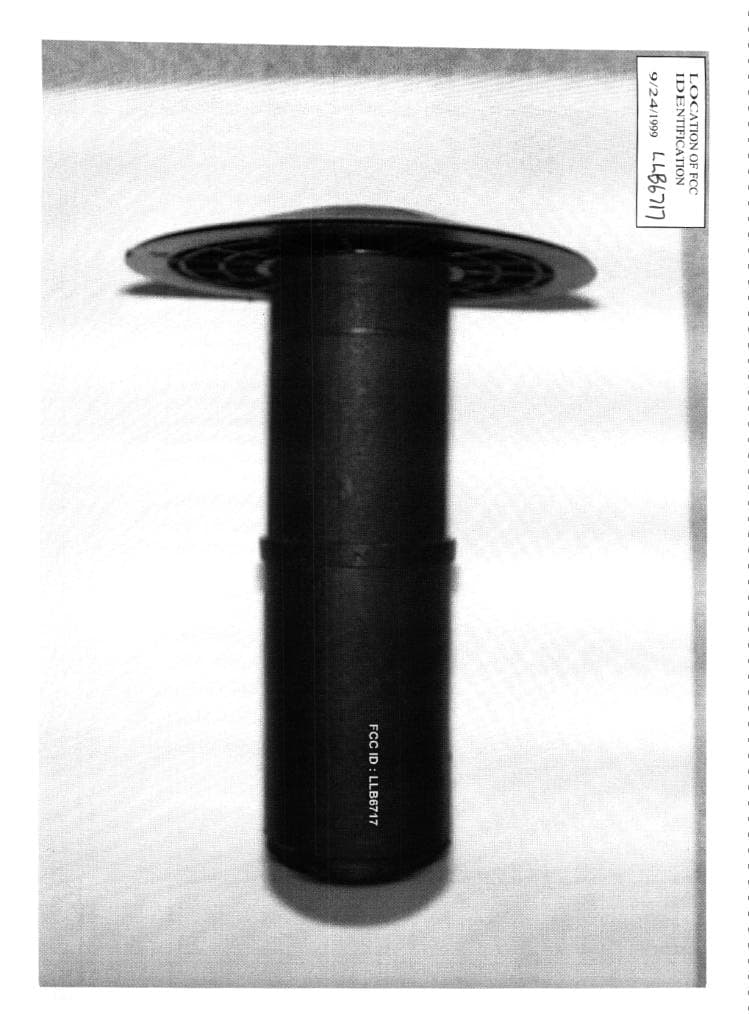
Click to zoom
Application Details
- Equipment Class
- TNB - Licensed Non-Broadcast Station Transmitter
- Date of Grant
- Jan 26, 2000
- Application Purpose
- Original Equipment
- Date of Application
- Sep 30, 1999
- Equipment Note
- Telemetry Transmitter for Automatic Meter Reading
- Frequency Range
- 450.00000000 - 470.00000000
- Company
- Aclara Technologies LLC
- Country
- United States
Documents & Files
Document Text
Text extracted from the exhibit documents filed with the FCC. Open a document above to read the original.
Cover Letter(s)
LLB6717 LIST OF EXHIBITS 1. Cover Letters Request for Confidentiality Previous Type Acceptance of Similar Device 2. Exhibit A ID Label Photo 3. Exhibit B Circuit Board Photos 4. Exhibit C Block Diagram, Schematic 5. Exhibit D Description of Operation 6. Exhibit E Test Reports 7. Exhibit F Instruction Manual Sept. 24, 1999 Federal Communications Commission Office of Engineering and Technology Equipment Approval Services RE: Request for Confidentiality Attached Form 731 – Application for Equipment Authorization FCC ID: LLB6717 Dear Sir or Madam: Hexagram, Inc. does not wish to publicly disclose certain technical information which is enclosed with this application. This material contains critical trade secrets and we request that the Commission withhold this information from public inspection pursuant to the provisions of Section 0.457(d) of the Rules. MATERIAL TO BE HELD CONFIDENTIAL: Exhibit BCircuit Board PhotosTwo pages Exhibit CBlock Diagram, Schematics Four pages Exhibit DDescription of OperationTwo pages This material is confidential and is not available to the public or end user. Sincerely, Lawrence M. Sears Director of Technology LS/sd Enclosure LLB6717 PREVIOUS TYPE ACCEPTANCE OF SIMILAR DEVICE The radio transmitter submitted herein (LLB6717) is to be used as a telemetry device for the reading of utility meters. The device periodically transmits meter reading information in brief transmissions lasting under one tenth of a second. Transmissions generally occur several times each day. An operationally identical device (LLB5891) was previously submitted for Type Acceptance and received a Grant of Type Acceptance on February 11, 1998. This earlier version has been in field service since the grant was issued. The product described in this application (LLB6717) is a modified version of LLB5891. The Block Diagram and basic circuit configuration of the new product is identical to that of the original LLB5891. As detailed in Exhibit D: Description of Operation, the semiconductor lineup has been changed from that of LLB5891 device in order to improve efficiency, reduce component count, and reduce manufacturing cost. Specific changes are shown below. • RF power amp – higher efficiency, higher output power • Voltage controlled Oscillator – miniaturization, cost • Data filter – miniaturization • RF preamp – higher efficiency, higher output power • 3.3 vdc regulator – miniaturization, cost • Rectifier diodes – miniaturization, cost • Digital Transistors – miniaturization, cost Also attached is a “Statement Concerning Compliance with Section 90.203 (j) (3).” The essentially identical statement was submitted with the application for Type Acceptance of the earlier LLB5891 device. Please Note: A second product, LLB6327, has been submitted for Certification at the same time as this application. LLB6717 STATEMENT CONCERNING COMPLIANCE WITH SECTION 90.203(j)(3) Introduction Section 90.203(j)(3) of the Commission’s Rules on transmitters provides, in pertinent part: If the equipment [in the 150-174 and 421-512 MHz bands] is capable of transmitting data and has an overall bandwidth of 6.25 kHz or more, the equipment must be capable of supporting a minimum data rate of 4800 bits per second per 6.25 kHz of bandwidth. 1 Three parties interested in remote utility metering sought reconsideration of this provision to allow alternative showings of spectrum efficiency for low power frequency reuse systems. 2 The Commission replied: [W]e will provide manufacturers with additional flexibility to design spectrally efficient transmitters. The Commission’s Equipment Authorization Division may, on a case by case basis, grant type acceptance to equipment with slower bit rates than specified in Sections 90.203(j)(3) and 90.203(j)(5) of our rules, provided that an acceptable technical analysis is submitted with the application which demonstrates that the slower data rate will provide more spectral efficiency than the standard data rate. 3 The present application is for automatic remote meter reading equipment, and falls squarely within the scope of this exception. When considered as part of a system, the device in question provides spectrum efficiency and channel utilization far in excess of 4800 bits/sec per 6.25 kHz. Technical Analysis The device submitted for type acceptance is a Meter Transmitter Unit (MTU). When the system is implemented, an MTU is attached to each utility meter. The MTU periodically transmits meter readings omnidirectionally in transmissions lasting under one-tenth second each. Transmissions from different MTUs are independent and uncorrelated. ___________________ 1 47 C.F.R. para. 90.203(j)(3). This provision governs Part 90 type acceptance applications filed from August 1, 1996, through December 31, 2004. 2 Replacement of Part 90 by Part 88 to Revise the Private Land Mobile Radio Services, 11 FCC Rcd 17676, 17686 (1996). 3 Id., 11 FCC Rcd at 17687 (emphasis added). LLB6717 Data Collection Units (DCUs) are mounted on a nominal one mile grid. A DCU receives and stores the transmissions from all the MTUs in its range. Once daily, each DCU transfers the accumulated data to a central computer at the utility office via a cellular phone mounted on the DCU. MTU bandwidth is 12.5 kHz, so a strict application of Section 90.203(j)(3) would require the equipment to support a data rate of 9600 bits/sec. In fact, to minimize component cost and bit error rate, an individual MTU transmits at the rate of 1200 bits/sec. The system achieves spectrum efficiency not through a high bit rate in each individual MTU, but through a high level of frequency re-use achieved by deploying a large number of low-power short range transmitters. As detailed in the attached Appendix, a typical large installation of MTUs on a single 12.5 kHz channel can support data rates exceeding 100,000 bits/sec. This performance represents spectrum efficiency far in excess of that required under Section 90.203(j)(3). Where a typical commercial u…
Text truncated - open the document above for the full version.
Cover Letter(s)
LLB6717 LIST OF EXHIBITS 1. Cover Letters Request for Confidentiality Previous Type Acceptance of Similar Device 2. Exhibit A ID Label Photo 3. Exhibit B Circuit Board Photos 4. Exhibit C Block Diagram, Schematic 5. Exhibit D Description of Operation 6. Exhibit E Test Reports 7. Exhibit F Instruction Manual Jan. 21, 2000 Federal Communications Commission Office of Engineering and Technology Equipment Approval Services RE: Request for Confidentiality Attached Form 731 – Application for Equipment Authorization FCC ID: LLB6717 Dear Sir or Madam: This letter is a replacement for the original cover letter dated Sept. 24/99 that was filed with the LLB6717 application referenced above. The only change is that the item titled “Exhibit B Circuit Board Photos Two pages” has been removed from the list of “Material to be Held Confidential”. All other text in this cover letter remains the same as in the original. Hexagram, Inc. does not wish to publicly disclose certain technical information which is enclosed with this application. This material contains critical trade secrets and we request that the Commission withhold this information from public inspection pursuant to the provisions of Section 0.457(d) of the Rules. MATERIAL TO BE HELD CONFIDENTIAL: Exhibit CBlock Diagram, Schematics Four pages Exhibit DDescription of OperationTwo pages This material is confidential and is not available to the public or end user. Sincerely, Lawrence M. Sears Director of Technology LS/sd Enclosure LLB6717 PREVIOUS TYPE ACCEPTANCE OF SIMILAR DEVICE The radio transmitter submitted herein (LLB6717) is to be used as a telemetry device for the reading of utility meters. The device periodically transmits meter reading information in brief transmissions lasting under one tenth of a second. Transmissions generally occur several times each day. An operationally identical device (LLB5891) was previously submitted for Type Acceptance and received a Grant of Type Acceptance on February 11, 1998. This earlier version has been in field service since the grant was issued. The product described in this application (LLB6717) is a modified version of LLB5891. The Block Diagram and basic circuit configuration of the new product is identical to that of the original LLB5891. As detailed in Exhibit D: Description of Operation, the semiconductor lineup has been changed from that of LLB5891 device in order to improve efficiency, reduce component count, and reduce manufacturing cost. Specific changes are shown below. • RF power amp – higher efficiency, higher output power • Voltage controlled Oscillator – miniaturization, cost • Data filter – miniaturization • RF preamp – higher efficiency, higher output power • 3.3 vdc regulator – miniaturization, cost • Rectifier diodes – miniaturization, cost • Digital Transistors – miniaturization, cost Also attached is a “Statement Concerning Compliance with Section 90.203 (j) (3).” The essentially identical statement was submitted with the application for Type Acceptance of the earlier LLB5891 device. Please Note: A second product, LLB6327, has been submitted for Certification at the same time as this application. LLB6717 STATEMENT CONCERNING COMPLIANCE WITH SECTION 90.203(j)(3) Introduction Section 90.203(j)(3) of the Commission’s Rules on transmitters provides, in pertinent part: If the equipment [in the 150-174 and 421-512 MHz bands] is capable of transmitting data and has an overall bandwidth of 6.25 kHz or more, the equipment must be capable of supporting a minimum data rate of 4800 bits per second per 6.25 kHz of bandwidth. 1 Three parties interested in remote utility metering sought reconsideration of this provision to allow alternative showings of spectrum efficiency for low power frequency reuse systems. 2 The Commission replied: [W]e will provide manufacturers with additional flexibility to design spectrally efficient transmitters. The Commission’s Equipment Authorization Division may, on a case by case basis, grant type acceptance to equipment with slower bit rates than specified in Sections 90.203(j)(3) and 90.203(j)(5) of our rules, provided that an acceptable technical analysis is submitted with the application which demonstrates that the slower data rate will provide more spectral efficiency than the standard data rate. 3 The present application is for automatic remote meter reading equipment, and falls squarely within the scope of this exception. When considered as part of a system, the device in question provides spectrum efficiency and channel utilization far in excess of 4800 bits/sec per 6.25 kHz. Technical Analysis The device submitted for type acceptance is a Meter Transmitter Unit (MTU). When the system is implemented, an MTU is attached to each utility meter. The MTU periodically transmits meter readings omnidirectionally in transmissions lasting under one-tenth second each. Transmissions from different MTUs are independent and uncorrelated. ___________________ 1 47 C.F.R. para. 90.203(j)(3). This provision governs Part 90 type acceptance applications filed from August 1, 1996, through December 31, 2004. 2 Replacement of Part 90 by Part 88 to Revise the Private Land Mobile Radio Services, 11 FCC Rcd 17676, 17686 (1996). 3 Id., 11 FCC Rcd at 17687 (emphasis added). LLB6717 Data Collection Units (DCUs) are mounted on a nominal one mile grid. A DCU receives and stores the transmissions from all the MTUs in its range. Once daily, each DCU transfers the accumulated data to a central computer at the utility office via a cellular phone mounted on the DCU. MTU bandwidth is 12.5 kHz, so a strict application of Section 90.203(j)(3) would require the equipment to support a data rate of 9600 bits/sec. In fact, to minimize component cost and bit error rate, an individual MTU transmits at the rate of 1200 bits/sec. The system achieves spectrum efficiency not through a high bit rate in each individual MTU, but through a high level of frequency re-use achieved by deploying a large number of l…
Text truncated - open the document above for the full version.
Internal Photos
HEXAGRAM, INC. FCC ID: LLB6717 CONFIDENTIAL INFORMATION EXHIBITS B, C, AND D PITSET CIRCUITBOARDVIEW # 1 LLB6717 PITSET CIRCUITBOARDVIEW # 2 LLB6717
Test Report
EXHIBIT E2 Hexagram Transmitter FCC ID: LLB6717 FREQUENCY STABILITY VS. VOLTAGE Instruments Used: HP 500 MHz Universal Counter Model 5328A S/N 1848A10091 10 MHz Rubidium Frequency Standard EFRATOM Model FRK-L S/N 25016879 Fluke Digital Voltmeter Model 8050A Variable DC Power Supply Assigned Frequency = 460.0000 MHz Battery FrequencyVariance Voltage (MHz) (PPM) 3.60460.000 415+0.90 3.50460.000 261+0.57 3.40460.000 370+0.80 3.30460.000 292+0.63 3.20460.000 225 +0.49 3.10460.000 180+0.39 3.00460.000 327+0.71 2.90460.000 276+0.60 2.80 460.000 242+0.53 2.70460.000 421+0.92 Microcontroller disables operation below this voltage. Measurements made and recorded by: ______________________________ Sept. 27, 1999Nathan R. Jacob P. Eng Hexagram Transmitter FCC ID: LLB6717 FREQUENCY STABILITY VS. TEMPERATURE Instruments Used: HP 500 MHz Universal Counter Model 5328A S/N 1848A10091 10 MHz Rubidium Frequency Standard EFRATOM Model FRK-L S/N 25016879 Associated Environmental Chamber Model EK2114 Assigned Frequency = 460.0000 MHz Temperature Frequency Variance (°C) (MHz) (PPM) 50459.999 9900.02 40459.999 8850.25 30459.999 8000.43 20459.999 9470.12 10460.000 0780.17 0459.999 9450.12 -10459.999 7770.49 -20459.999 7500.54 -30459.999 8750.27 Microcontroller disables operation beyond this temperature range. Measurements made and recorded by: ________________________________ Sept. 27, 1999Nathan R. Jacob P. Eng.
Test Report
EXHIBIT E2 Hexagram Transmitter FCC ID: LLB6717 FREQUENCY STABILITY VS. VOLTAGE Instruments Used: HP 500 MHz Universal Counter Model 5328A S/N 1848A10091 10 MHz Rubidium Frequency Standard EFRATOM Model FRK-L S/N 25016879 Fluke Digital Voltmeter Model 8050A Variable DC Power Supply Assigned Frequency = 460.0000 MHz Battery FrequencyVariance Voltage (MHz) (PPM) 3.60460.000 415+0.90 3.50460.000 261+0.57 3.40460.000 370+0.80 3.30460.000 292+0.63 3.20460.000 225 +0.49 3.10460.000 180+0.39 3.00460.000 327+0.71 2.90460.000 276+0.60 2.80 460.000 242+0.53 2.70460.000 421+0.92 Microcontroller disables operation below this voltage. Measurements made and recorded by: ______________________________ Sept. 27, 1999Nathan R. Jacob P. Eng Hexagram Transmitter FCC ID: LLB6717 FREQUENCY STABILITY VS. TEMPERATURE Instruments Used: HP 500 MHz Universal Counter Model 5328A S/N 1848A10091 10 MHz Rubidium Frequency Standard EFRATOM Model FRK-L S/N 25016879 Associated Environmental Chamber Model EK2114 Assigned Frequency = 460.0000 MHz Temperature Frequency Variance (°C) (MHz) (PPM) 50459.999 9900.02 40459.999 8850.25 30459.999 8000.43 20459.999 9470.12 10460.000 0780.17 0459.999 9450.12 -10459.999 7770.49 -20459.999 7500.54 -30459.999 8750.27 Microcontroller disables operation beyond this temperature range. Measurements made and recorded by: ________________________________ Sept. 27, 1999Nathan R. Jacob P. Eng.
Contact Information
Applicant
John Cunningham(VP, Chief Engineer)
Technical Contact
Hexagram Inc.Lawrence M Sears
[email protected]216-464-1057
23905 Mercantile Rd. · Cleveland, Ohio · United States
Non-Technical Contact
HexagramLawrence M Sears
[email protected]216-464-1057
Test Firm
Smith Electronics, Inc.James Pollock
Technical Specifications
| # | Rule Parts | Frequency Range | Power Output | Emission | Tolerance |
|---|---|---|---|---|---|
| 1 | 90 | 450 MHz - 470 MHz | 348.00 mW | 7K20F1D | 2.5000000000 ppm |
Other Applications from Aclara Technologies LLC
LLB-095370
Jun 18, 2026Wireless Current Sensor for Capacitor Bank Applications
Equipment Class
DTS - Digital Transmission System
LLBY84092-1
Nov 10, 2022RF Endpoint
Equipment Class
TNB - Licensed Non-Broadcast Station Transmitter
LLB2020001
Apr 04, 2022Aclara Core Module transceiver
Equipment Class
TNB - Licensed Non-Broadcast Station Transmitter
LLB2019006
Aug 04, 2020Water Meter Transponding Unit (MTU)
Equipment Class
TNB - Licensed Non-Broadcast Station Transmitter
LLB2015001
Dec 10, 2015Series 4000 MTU
Equipment Class
TNB - Licensed Non-Broadcast Station Transmitter