OSZ37704C5GHz Low Power Cardbus WLAN Card
Conexant Systems Inc.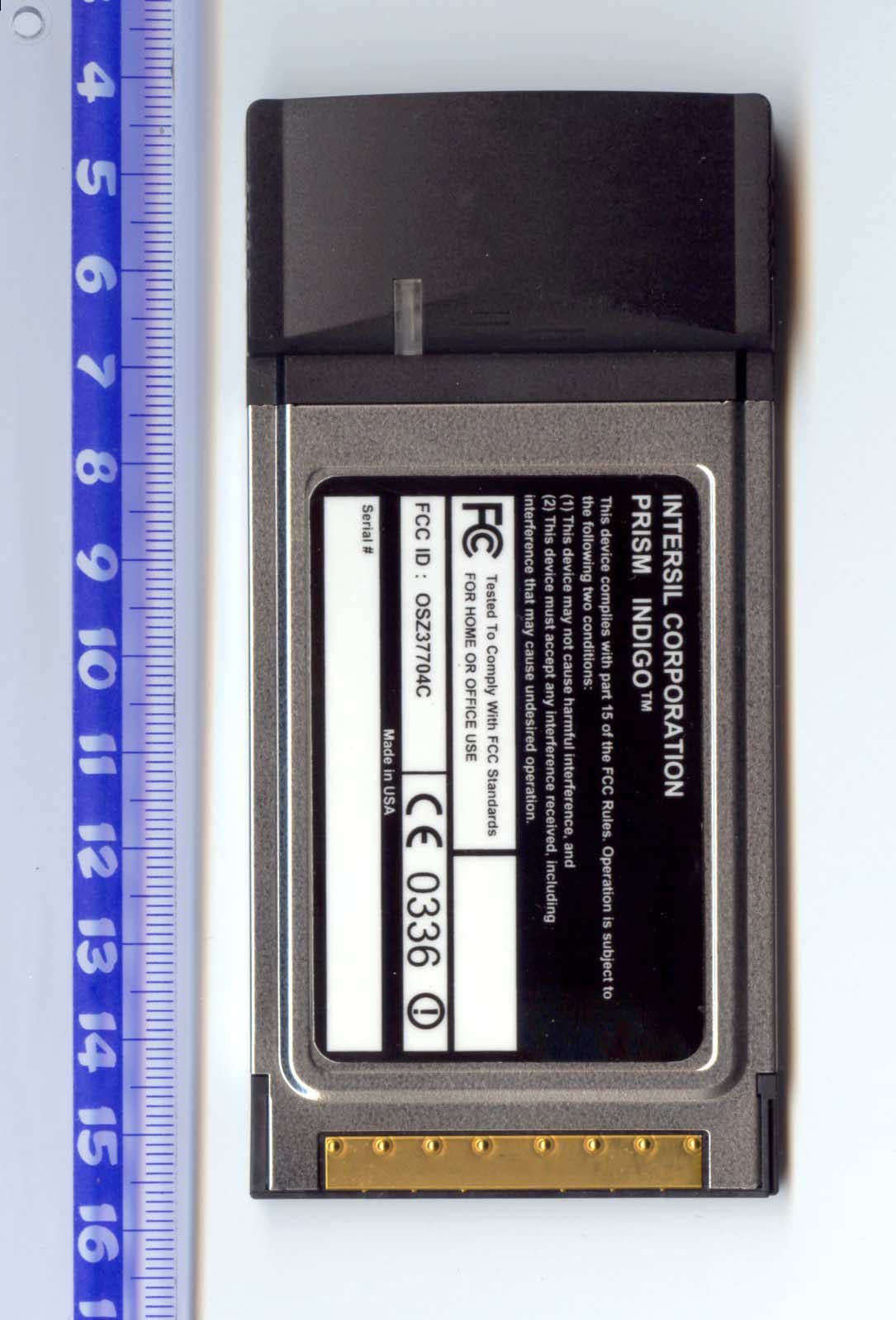
Click to zoom
Application Details
- Equipment Class
- NII - Unlicensed National Information Infrastructure TX
- Date of Grant
- Dec 16, 2002
- Application Purpose
- Original Equipment
- Date of Application
- Sep 29, 2002
- Equipment Note
- 5GHz Low Power Cardbus WLAN Card
- Frequency Range
- 5250.00000000 - 5350.00000000
- Company
- Conexant Systems Inc.
- Country
- United States
Documents & Files
Document Text
Text extracted from the exhibit documents filed with the FCC. Open a document above to read the original.
Users Manual
ISL37704C Indigo Cardbus manual (preliminary) Page1of3 Section xx: Regulatory notes IEEE802.11 frequency assignments UNII band RF channel FrequencyFCC USA ETSI EU MKK Japan Singa- pore Tai- wan 345170X 365180XXX 385190X 405200XXX 425210X 445220XXX 465230X 1 5150 5250 485240XXX 525260XXXX 565280XXXX 605300XXXX 2 5250 5350 645320XXXX 1495745XXX 1535765XXX 1575785XXX 3 5725 5850 1615805XXX Table xx: IEEE802.11a channels Caution: Within 5.15 to 5.25 MHz bands, UNII devices arerestricted to indoor operationsto reduce any potential harmfull interference to co-channel Mobile Satelite Systems (MSS) operations. This Indigo device is shipped with FCC-compliant firmware. In order to ensure regulatory-compliant channel usage in a particular country, special geographic-specific firmware is available for customer production assemblies which restricts channel usage. Examples include ETSI-compliant firmware, MKK -compliant firmware etc. Since the end user does not have the ability to alter this firmware, regulatory compliance is ensured. Agency and Regulatory Body Approvals This Indigo device complies with the standards as shown in table below: countryApproval specificationnotes USAFCC part 15, sections 15.107, 15.109, 15.207, 15.209, 15.407 Tested at accredited laboratories and filed for FCC certification. European UnionEN 301 893 V1.1.1 (2001-01) ETSI EN 301 489-1 V1.3.1 (2001-07) ETSI EN 301 489-17 V1.1.1 (2000-09) EN60950 incl A1, A2, A3, A4 Tested at accredited laboratories and Notified according to article 6.4 of the RTTE directive JapanARIB STD T71 v.1.0, 14 december 2000Tested at TELEC laboratories and filed for MPT Japan certification. Table xx: Compliance specifications USA-FCC (Federal Communications Commission) statement This device complies with Part 15 of FCC Rules. Operation is subject to the following two conditions: 1.This device may not cause interference, and 2.this device must accept any interference, including interference that may cause undesired operation of this device. ISL37704C Indigo Cardbus manual (preliminary) Page2of3 FCC Interference Statement This equipment has been tested and found to comply with the limits for a Class B digital device, pursuant to Part 15 of the FCC Rules. These limits are designed to provide reasonable protection against harmful interference in a residential installation. This equipment generates, uses, and can radiate radio frequency energy. If not installed and used in accordance with the instructions, it may cause harmful interference to radio communications. However, there is no guarantee that interference will not occur in a particular installation. If this equipment does cause harmful interference to radio or television reception, which can be determined by turning the equipment off and on, the user is encouraged to try and correct the interference by one or more of the following measures: 1.Reorient or relocate the receiving antenna. 2.Increase the distance between the equipment and the receiver. 3.Connect the equipment to an outlet on a circuit different from that to which the receiver is connected. 4.Consult the dealer or an experienced radio/TV technician for help. Export restrictions: This product or software contains encryption code which may not be exported or transferred from the US or Canada without an approved US Department of Commerce export license. FCC Guidelines for Human Exposure The EIRP was measured for the lower, middle and highest frequencies used by the transmitter. The results in Table xx below are based on a safe distance between antenna and operator of 8 inches (20 centimeters).The equipment therefore fulfills the requirements on power density for general population / uncontrolled exposure of 1.0 mW/cm² and therefore complies with the requirements of FCC OET Bulletin 65 including supplements A, B and C. Channel 36Channel 48Channel 64 Measured EIRP (mW) 70.867.669.2 Specific absorption Ratio SAR ( mW/cm²) 0.060.050.06 Table xx: Compliance specifications Caution: To comply with FCC RF exposure compliance requirements, a separation distance of at least 20 cm must be maintained between the antenna of this device and all persons. Europe - EU R&TTE Declaration of Conformity This Wireless LAN Radio device is tested to and conforms with the essential radio test suites included in following standards: StandardDescription and Explanation LVD specification EN 60950 EN 60950,ed. (1992), incl. A1(1993), A2(1993), A3(1995) and A4(1997) Safety of information technology equipment, including electrical business equipment. Meets R&TTE directive art. 3.1.a of essential requirements on protection of the health and safety of the user. ETSI EMC specification ETSI EN 301 489 Electromagnetic compatibility and Radio spectrum Matters (ERM); Electromagnetic Compatibility (EMC) standard for radio equipment ISL37704C Indigo Cardbus manual (preliminary) Page3of3 StandardDescription and Explanation Part 1 V1.2.1 (2000-08) Part 17 V1.1.1 (2000-09) and services; Part 1: Common technical requirements Part 17: Specific conditions for Wideband data and HIPERLAN equipment ETSI RF specification EN 301 893 V1.1.1 (2001-01) Broadband Radio Access Networks (BRAN), HIPERLAN Type 2 Harmonised EN covering essential requirements of article 3.2 of the R&TTE Directive Table xx: EU RTTE Compliance specifications and therefore complies with the essential requirements and provisions of theDirective 1999/5/ECof the European Parliament and of the council of 9 march 1999 on Radio equipment and Telecommunications Terminal Equipment and the mutual recognition of their conformity and Annex IV (Conformity Assessment procedure referred to in article 10(4)). Important Notice : This device is a 5 GHz low power RF device intended for home and office use in EU and EFTA member states. In some EU / EFTA member states some restrictions may apply. Please contact local spectrum management authorithies for further details before putting this device into operation Wireless LAN installation g…
Text truncated - open the document above for the full version.
Users Manual
ISL37704C Indigo Cardbus manual (preliminary) rev. 2 Page 1 of 1 Section xx: Regulatory notes IEEE802.11 frequency assignments UNII band RF channel Frequency FCC USA ETSI EU MKK Japan Singa- pore Tai- wan 34 5170 X 36 5180 X X X 38 5190 X 40 5200 X X X 42 5210 X 44 5220 X X X 46 5230 X 1 5150 5250 48 5240 X X X 52 5260 X X X X 56 5280 X X X X 60 5300 X X X X 2 5250 5350 64 5320 X X X X 149 5745 X X X 153 5765 X X X 157 5785 X X X 3 5725 5850 161 5805 X X X Table xx: IEEE802.11a channels Caution: Within 5.15 to 5.25 MHz bands, UNII devices are restricted to indoor operations to reduce any potential harmfull interference to co-channel Mobile Satelite Systems (MSS) operations. This Indigo device is shipped with FCC-compliant firmware. In order to ensure regulatory-compliant channel usage in a particular country, special geographic-specific firmware is available for customer production assemblies which restricts channel usage. Examples include ETSI-compliant firmware, Japan -compliant firmware etc. Since the end user does not have the ability to alter this firmware, regulatory compliance is ensured. Agency and Regulatory Body Approvals This Indigo device complies with the standards as shown in table below: country Approval specification notes USA FCC part 15, sections 15.107, 15.109, 15.207, 15.209, 15.407 Tested at accredited laboratories and filed for FCC certification. European Union EN 301 893 V1.1.1 (2001-01) ETSI EN 301 489-1 V1.3.1 (2001-07) ETSI EN 301 489-17 V1.1.1 (2000-09) EN60950 incl A1, A2, A3, A4 Tested at accredited laboratories and Notified according to article 6.4 of the RTTE directive Japan ARIB STD T71 v.1.0, 14 december 2000 Tested at TELEC laboratories and filed for MPT Japan certification. Table xx: Compliance specifications USA-FCC (Federal Communications Commission) statement This device complies with Part 15 of FCC Rules. Operation is subject to the following two conditions: 1. This device may not cause interference, and 2. this device must accept any interference, including interference that may cause undesired operation of this device. ISL37704C Indigo Cardbus manual (preliminary) rev. 2 Page 2 of 2 FCC Interference Statement This equipment has been tested and found to comply with the limits for a Class B digital device, pursuant to Part 15 of the FCC Rules. These limits are designed to provide reasonable protection against harmful interference in a residential installation. This equipment generates, uses, and can radiate radio frequency energy. If not installed and used in accordance with the instructions, it may cause harmful interference to radio communications. However, there is no guarantee that interference will not occur in a particular installation. If this equipment does cause harmful interference to radio or television reception, which can be determined by turning the equipment off and on, the user is encouraged to try and correct the interference by one or more of the following measures: 1. Reorient or relocate the receiving antenna. 2. Increase the distance between the equipment and the receiver. 3. Connect the equipment to an outlet on a circuit different from that to which the receiver is connected. 4. Consult the dealer or an experienced radio/TV technician for help. Export restrictions: This product or software contains encryption code which may not be exported or transferred from the US or Canada without an approved US Department of Commerce export license. FCC Guidelines for Human Exposure SAR (Specific Absorption Rate) for this device was measured in accordance with FCC OET Bulletin 65 (Supplement C) and guidelines established in IEEE C95.1-1991. Based on these measurements, this device fulfills the SAR limits for general population / uncontrolled exposure Caution: In order to comply with RF exposure limits established in the ANSI C95.1 standards, the user is advised to maintain a distance of at least 1.0 cm from the antenna of this device while it is in use. If the antenna is positioned less than 1.0 cm from the user, it is recommended that the user limits the exposure time. Europe - EU R&TTE Declaration of Conformity This Wireless LAN Radio device is tested to and conforms with the essential radio test suites included in following standards: Standard Description and Explanation LVD specification EN 60950 EN 60950,ed. (1992), incl. A1(1993), A2(1993), A3(1995) and A4(1997) Safety of information technology equipment, including electrical business equipment. Meets R&TTE directive art. 3.1.a of essential requirements on protection of the health and safety of the user. ETSI EMC specification ETSI EN 301 489 Part 1 V1.2.1 (2000-08) Part 17 V1.1.1 (2000-09) Electromagnetic compatibility and Radio spectrum Matters (ERM); Electromagnetic Compatibility (EMC) standard for radio equipment and services; Part 1: Common technical requirements Part 17: Specific conditions for Wideband data and HIPERLAN equipment ETSI RF specification EN 301 893 Broadband Radio Access Networks (BRAN), HIPERLAN Type 2 Harmonised EN covering essential requirements of article 3.2 of ISL37704C Indigo Cardbus manual (preliminary) rev. 2 Page 3 of 3 Standard Description and Explanation V1.1.1 (2001-01) the R&TTE Directive Table xx: EU RTTE Compliance specifications and therefore complies with the essential requirements and provisions of the Directive 1999/5/EC of the European Parliament and of the council of 9 march 1999 on Radio equipment and Telecommunications Terminal Equipment and the mutual recognition of their conformity and Annex IV (Conformity Assessment procedure referred to in article 10(4)). Important Notice : This device is a 5 GHz low power RF device intended for home and office use in EU and EFTA member states. In some EU / EFTA member states some restrictions may apply. Please contact local spectrum management authorithies for further details before putting this device into operation EU versions of this Indigo WLAN device only have 4 channels in 5150-5250MHz band with…
Text truncated - open the document above for the full version.
Users Manual
Preliminary User manual FCC ID: OSZ37704C Page 1 of 10 Intersil ISL37704C Indigo IEEE802.11a 5 GHz WLAN Cardbus Card User Manual Version 0.1 Preliminary User manual FCC ID: OSZ37704C Page 2 of 10 Table of Contents 0-INTRODUCTION .................................................................................................... 3 1-CARD INSTALLATION PROCEDURE .............................................................. 3 1.1 I NSTALLING THE CARDBUS CARD INTO THE HOST PC NOTEBOOK................... 3 1.2 INSTALLING THE SOFTWARE DRIVERS................................................................ 3 1.3 WIRELESS LAN INSTALLATION GUIDE LINES AND AUTHORIZATION FOR USE.7 1.4 IEEE 802.11 FREQUENCY ASSIGNMENTS........................................................... 7 2-REGULATORY INFORMATION ........................................................................ 8 2.1 FCC I NFORMATION TO USER............................................................................. 8 2.2 P RODUCT COMPLIANCE...................................................................................... 8 2.3 USA-FCC (FEDERAL COMMUNICATIONS COMMISSION) STATEMENT............ 8 2.4 FCC I NTERFERENCE STATEMENT..................................................................... 8 2.5 E XPORT RESTRICTIONS:..................................................................................... 9 2.6 FCC GUIDELINES FOR HUMAN EXPOSURE........................................................ 9 2.7 EUROPE - EU R&TTE DECLARATION OF CONFORMITY................................. 9 3-TECHNICAL SPECIFICATIONS....................................................................... 10 Preliminary User manual FCC ID: OSZ37704C Page 3 of 10 0-Introduction The Intersil ISL37704C WLAN Cardbus Card is a complete wireless high speed Network Interface Card (NIC) utilizing the Intersil PRISM® 5 chip set. It provides a complete PRISM 5 reference design evaluation platform of hardware and software to system providers or integrators requiring wireless data communications capability and is ideal for integration into computer platforms. It supports the IEEE 802.11a specification, providing data rates of 54, 48, 36, 24, 18, 12, 9, and 6 Mbps. Access Points are available from a number of suppliers, enabling a total wireless network solution. • FCC Certified Under Part 15 to Operate in 5GHz ISM Band • Support for 54, 48, 36, 24, 18, 12, 9, and 6 Megabit Per Second (Mbps) Data Rates • Supports the lEEE 802.11a Specification • Driver Supports Microsoft® Windows® 98/SE, ME, XP, 2000 (SR1) • Supports Dual Diversity Antennas • Provides Wireless Data Communications to support live video applications • Intelligent Power Control, Including 802.11 Power Save Mode 1-Card Installation procedure 1.1 Installing the Cardbus card into the host PC Notebook a-insert Cardbus Card into Cardbus slot of PC host notebook 1.2 Installing the software drivers a-Start windows b-When windows detects new hardware and asks for drivers, point to directory where the Intersil driver is located (for example floppy drive, cdrom , harddisk) to install. c-after drivers are installed, restart windows d-the Intersil WLAN icon will appear in system tray on the bottom right of the screen (see yellow arrow in fig. 01) fig, 01: Intersil WLAN icon Preliminary User manual FCC ID: OSZ37704C Page 4 of 10 e-double click the Intersil WLAN icon to open the WLAN settings, the following window will appear (see fig.02) fig, 02: Intersil WLAN settings window f-click on configuration tab and select which type of network is required (access point or Peer-to-peer mode), see fig. 03. fig, 03: WLAN network type setting window Preliminary User manual FCC ID: OSZ37704C Page 5 of 10 g-select what TX rate is required (default setting is fully automatic) see fig. 04. fig, 04: WLAN tx rate setting window h-select what encryption type is required, 64 or 128 bit WEP (default setting is disabled) see fig. 05. fig, 05: WLAN encryption rate setting window Preliminary User manual FCC ID: OSZ37704C Page 6 of 10 i-click on the status tab to see the connection status (fig.06). fig, 06: WLAN network status j-click on the about tab to see the software drivers versions and MAC address (fig.07). fig, 07: WLAN driver and MAC addres information Preliminary User manual FCC ID: OSZ37704C Page 7 of 10 1.3 Wireless LAN installation guide lines and Authorization for use Installation and use of this Wireless LAN device must be in strict accordance with the instructions included in the user documentation provided with the product. Any changes or modifications made to this device that are not expressly approved by Intersil may void the user’s authority to operate the equipment. Intersil is not responsible for any radio or television interference caused by unauthorized modification of this device, or the substitution or attachment of connecting cables and equipment other than specified. It is the responsibility of the user to correct any interference caused by such unauthorized modification, substitution or attachment. Intersil and its authorized resellers or distributors will assume no liability for any damage or violation of government regulations arising from failing to comply with these guidelines. The use of Wireless LAN devices may be restricted in some situations or environments for example: * On board of airplanes, or * In an explosive environment, or * In case the interference risk to other devices or services is perceived or identified as harmful. In case the policy regarding the use of Wireless LAN devices in specific organizations or environments (e.g. airports, hospitals, chemical/oil/gas industrial plants, private buildings etc.) is not clear, please first verify authorization to use these devices prior to operating the equipment. 1.4 IEEE 802.11 frequency assignments This Indigo device is shipped with FCC-compliant firmware. In order to ensure regulatory-compliant channel usage in a particular country, special geographic-…
Text truncated - open the document above for the full version.
Cover Letter(s)
December 11, 2002 To: Steve Dayhoff [email protected] FCC Application Processing Branch Re: FCC ID OSZ37704C Applicant: Intersil Corporation Correspondence Reference Number: 24490 731 Confirmation Number: EA153277 1) Further to reply to Crn 24350 8) please submit legible photo of 5ghz band validation dipole. A1) < 5.24GHz Validation Dipole > 2) Per 2.1033(b)(3) please submit complete users installation and operating instructions manual. 3) Please submit close-up photo showing side view of notebook computer in normal use position at flat phantom with card installed. A3) < Close-up view - Keyboard faced inward the phantom > < Close-up view – Keyboard faced outward the phantom > 4) Per discussion between Tim Harrington of FCC lab and Victor Kee of Ultratech, SAR reports needs re-formatting. Please submit revised version. A4) The revised version is attached. 5) What is SAR flat phantom thickness and loss tangent or conductivity (prefer measured)? A5) The flat phantom detail Thickness of the bottom: 2 [mm] Material of the bottom : Polycarbonate From the information provided by the material supplier Loss tangent (dissipation factor) : 0.01 (10 6 cycle) Measurement using Agilent 85070C Dielectric Probe Kit Loss tangent (dissipation factor) @ 5.24 GHz : 0.06 Dielectric Constant @ 5.24 GHz : 3.1119 6) Is there a duty factor involved in SAR tests - what is source-based time-averaged output power? A6) Tested with 100 % duty cycle (CW) instead of with its actual duty cycle, using the controlling software provided by the manufacturer EXCLUSIVELY for SAR test. Thus SAR can be expected to become lower, roughly, by the ratio of the actual duty cycle under normal usage situation. 7) Please confirm or repeat if needed the notebook parallel SAR value less than 0.01 W/kg (also maybe the 5mm reading). The data for host parallel seems a little inconsistent with expected SAR rolloff vs source distance compared to the 5mm SAR. A7) We were not able to understand quite well what is the point of this question. Please advise us more specific. The SAR values less than 0.01 W/Kg were the cases that the EUT was made to be positioned parallel to the phantom and the separation distances were 13 mm and 15 mm respectively. When we considered the measured field decay versus distance in our report, we couldn’t find any inconsistency with respect to the expected SAR roll-off. Please feel free to contact us if you have any questions Best Regards JaeWook Choi. Ultratech Engineering Labs Inc. 3000 Bristol Circle Oakville, Ontario Canada L6H 6G4
External Photos
FCC ID: OSZ37704CPage 1 of 2 External photographs of Description: 5 GHz WLAN Cardbus client card FCC ID: OSZ37704C Brand name: Intersil Model number: ISL37704C FCC ID: OSZ37704CPage 2 of 2 ISL37704C Exterior with label
RF Exposure Info
UltraTech Group of Labs September 16, 2002 Intersil Corporation 2401 Palm Bay Road Florida, USA Attn.: Derick Sariredjo Subject: Verification Testing in accordance with SAR (Specific Absorption Rate) requirements using guidelines established in: IEEE C95.1-1991, FCC OET Bulletin 65 (Supplement C) Industry Canada RSS-102 (Issue 1) ACA Radiocommunications (Electromagnetic Radiation – Human Exposure) Amendment Standard 2000 (No. 1) Product: PRISM INDIGO TM Model: ISL37704C Dear Mr. Sariredjo The product sample has been tested in accordance with SAR (Specific Absorption Rate) requirements using guidelines established in IEEE C95.1-1991, FCC OET Bulletin 65 (Supplement C), Industry Canada RSS-102 (Issue 1)and ACA Radiocommunications (Electromagnetic Radiation – Human Exposure) Amendment Standard 2000 (No. 1), and the results and observation were recorded in the engineering report, Our File No.: ITS-003-SAR Enclosed you will find a copy of the engineering report. If you have any queries, please do not hesitate to contact us. Yours truly, Tri Minh Luu, P.Eng Vice President - Engineering Encl. 31040/SIT A96/TH/0093 46390-2049 200093-0 2 00-034 3000 Bristol Circle, Oakville, Ontario, Canada L6H 6G4 Telephone (905) 829-1570 Facsimile (905) 829-8050 Website: www.ultratech-labs.com Email: [email protected] September 16, 2002 File No.: ITS-003-SAR Intersil Corporation Rembrandtlaan 1a 3723 BG Bilthoven P.O. Box 343 3720 AH Bilthoven The Netherlands NOT TRANSFERABLE This Verification Certificate is hereby issued to the named GRANTEE and is VALID ONLY for the equipment identified hereon for use under the rules and regulations listed below: GRANTEE'S NAME: Intersil Corporation PRODUCT UNDER TEST: PRISM INDIGO TM MODEL NO.: ISL37704C FCC ID: OSZ37704C OPERATING FREQUENCY RANGE: 5180 ~ 5320 MHz RATED RF OUTPUT POWER: 17.19 dBm conducted EXPOSURE CATEGORY: General Population/Uncontrolled MAX. PEAK SPATIAL-AVERAGE SAR 1g : 0.975 W/Kg with 5 mm separation distance APPLICABLE STANDARDS: SAR (Specific Absorption Rate) requirements using guidelines established in IEEE C95.1-1991, FCC OET Bulletin 65 (Supplement C), Industry Canada RSS-102(Issue 1) and ACA Radiocommunications (Electromagnetic Radiation – Human Exposure) Amendment Standard 2000 (No. 1) • Assessed by ITI (UK) Competent Body, NVLAP (USA) Accreditation Body & ACA/AUSTEL (Australia), VCCI (Japan) • Accredited by Industry Canada (Canada) under ACC-LAB (Europe/Canada MRA and APEC/Canada MRA) • Recognized/Listed by FCC (USA ) • All test results contained in this engineering test report are traceable to National Institute of Standards and Technology (NIST Technology ( NIST) Approved by: Tri M. Luu, P.Eng. V.P. – Engineering UltraTech 3000 Bristol Circle, Oakville, Ontario, Canada, L6H 6G4 Telephone (905) 829-1570 Facsimile (905) 829-8050 Website: www.ultratech-labs.com Email: [email protected]
Test Report
Testing and certification of, consultancy and research concerning, electronic and electric appliances, systems, installations and telecommunication systems TNO Electronic Products & Services (EPS) B.V. P.O. Box 15 9822 ZG Niekerk (NL) Smidshornerweg 18 9822 TL Niekerk (NL) Telephone: +31 594 505005 Telefax: +31 594 504804 E-mail: [email protected] Project number: 02062701.r01 Page 1 of 55 TEST REPORT OF A 5 GHZ LOW POWER WLAN CARDBUS CARD, BRAND INTERSIL, TYPE ISL37704C, IN CONFORMITY WITH 47 CFR PART 15 (2001-12-18). FCC listed Industry Canada : : 90828 IC3501 Test specification(s): Description of EUT: Manufacturer: Brand mark: Type: FCC ID: 47 CFR Part 15 (2001-12-18) 5 GHz low power WLAN Cardbus card Intersil Corporation Intersil ISL37704C OSZ37704C Project number: 02062701.r01 Page 2 of 55 MEASUREMENT/TECHNICAL REPORT Intersil Corporation Model : ISL37704C FCC ID: OSZ37704C August 6, 2002 This report concerns: Original grant/certification Class 2 change Verification Equipment type: Unlicensed U-NII Device Deferred grant requested per 47 CFR 0.457(d)(1)(ii) ? Yes No Report prepared by: Name : P.A.J.M. Robben, B.Sc.E.E. Company name : TNO Electronic Products & Services (EPS) B.V. Address : Smidshornerweg 18 Postal code/city : 9822 ZG Niekerk Mailing address : P.O. Box 15 Postal code/city : 9822 TL Niekerk Country : The Netherlands Telephone number : + 31 594 505 005 Telefax number : + 31 594 504 804 E-mail : [email protected] The data taken for this test and report herein was done in accordance with 47 CFR Part 15 and the measurement procedures of ANSI C63.4-1992. TNO Electronic Products & Services (EPS) B.V. at Niekerk, The Netherlands, certifies that the data is accurate and contains a true representation of the emission profile of the Equipment Under Test (EUT) on the date of the test as noted in the test report. I have reviewed the test report and find it to be an accurate description of the test(s) performed and the EUT so tested. Date: August 6, 2002 Signature: P. de Beer TNO Electronic Products & Services (EPS) B.V. Test specification(s): Description of EUT: Manufacturer: Brand mark: Type: FCC ID: 47 CFR Part 15 (2001-12-18) 5 GHz low power WLAN Cardbus card Intersil Corporation Intersil ISL37704C OSZ37704C Project number: 02062701.r01 Page 3 of 55 Description of test item Test item : 5 GHz low power WLAN Cardbus card Manufacturer : Intersil Corporation Brand : Intersil Type : ISL37704C Serial numbers : 0222 0084 Revision : C8 Receipt number : 1 Receipt date : June 25, 2002 Applicant information Applicant's representative : Mr. D. Sariredjo Company : Intersil Corporation Address : Rembrandtlaan 1a Postal code : 3723 BG City : Bilthoven PO-box : 343 Postal code : 3720 AH City : Bilthoven Country : The Netherlands Telephone number : +31 30 225 9742 Telefax number : +31 30 229 6061 Test(s) performed Location : Niekerk Test(s) started : June 25, 2002 Test(s) completed : July 9, 2002 Purpose of test(s) : Type approval / certification Test specification(s) : 47 CFR Part 15 (2001-12-18) Test engineer : O.H. Hoekstra Report written by : P.A.J.M. Robben, B.Sc.E.E. Project leader : O.H. Hoekstra This report is in conformity with NEN-EN-ISO/IEC 17025: 2000. This report shall not be reproduced, except in full, without the written permission of TNO Electronic Products & Services (EPS) B.V. The test results relate only to the item(s) tested. Test specification(s): Description of EUT: Manufacturer: Brand mark: Type: FCC ID: 47 CFR Part 15 (2001-12-18) 5 GHz low power WLAN Cardbus card Intersil Corporation Intersil ISL37704C OSZ37704C Project number: 02062701.r01 Page 4 of 55 Table of contents 1 General information................................................................................................................................................................. 5 1.1 Product description. ......................................................................................................................................................... 5 1.2 Related submittal(s) and/or Grant(s). .............................................................................................................................. 5 1.3 Tested system details. ...................................................................................................................................................... 5 1.4 Test methodology. ........................................................................................................................................................... 6 1.5 Test facility. ..................................................................................................................................................................... 6 1.6 Product labeling. .............................................................................................................................................................. 6 1.7 System test configuration. ............................................................................................................................................... 7 1.7.1 Justification.............................................................................................................................................................. 7 1.7.2 EUT exercise software............................................................................................................................................. 7 1.8 Special accessories. ......................................................................................................................................................... 7 1.9 Equipment modifications................................................................................................................................................. 8 1.10 Configuration of the tested system. ................................................................................................................................. 8 1.11 Block diagram(s) of t…
Text truncated - open the document above for the full version.
Test Setup Photos
Testing and certification of, consultancy and research concerning, electronic and electric appliances, systems, installations and telecommunication systems TNO Electronic Products & Services (EPS) B.V. P.O. Box 15 9822 ZG Niekerk (NL) Smidshornerweg 18 9822 TL Niekerk (NL) Telephone: +31 594 505005 Telefax: +31 594 504804 E-mail: [email protected]…
Text truncated - open the document above for the full version.
Contact Information
Applicant
Derick Sariredjo
Technical Contact
Bay Area Compliance Laboratory Corp.John Chan
[email protected](408) 732 9162
230 Commercial Street · Sunnyvale, California · United States
Non-Technical Contact
Bay Area Compliance Laboratory Corp.John Chan
[email protected](408) 732 9162
Test Firm
TUV Rheinland Nederland B.V.Ties E. T Koning
Technical Specifications
| # | Rule Parts | Frequency Range | Power Output |
|---|---|---|---|
| 2 | 15E | 5.25 GHz - 5.35 GHz | 69.20 mW |
Other Applications from Conexant Systems Inc.
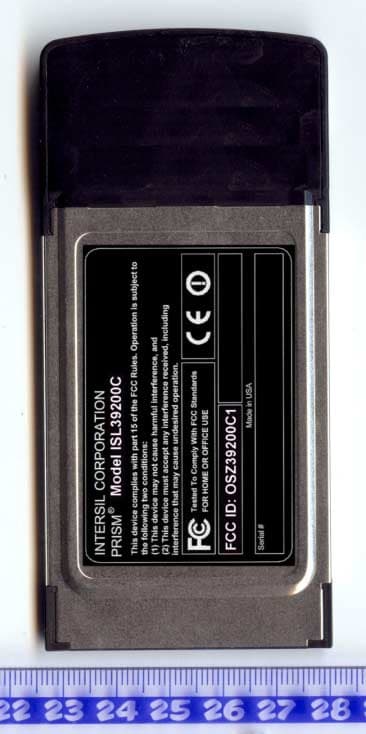
OSZ39200C1
Dec 08, 20032.4/5 GHz IEEE 802.11g/a WLAN Cardbus card
Equipment Class
NII - Unlicensed National Information Infrastructure TX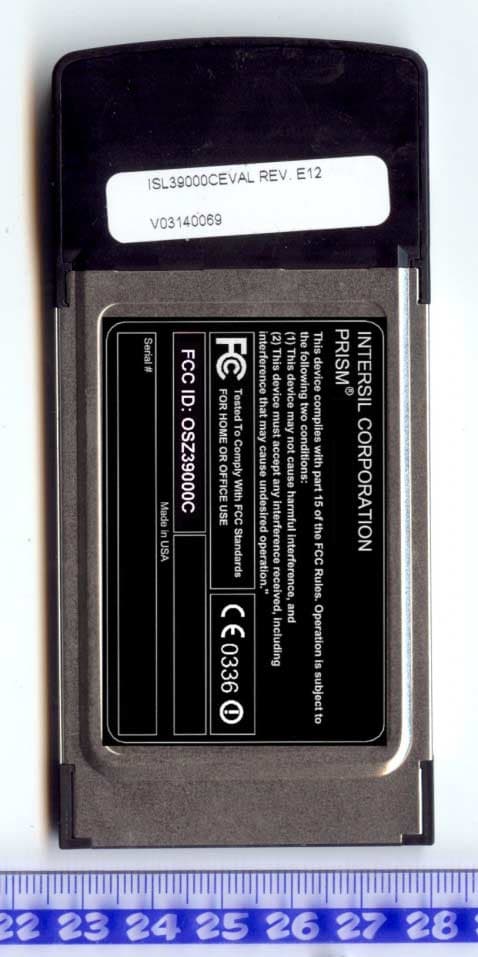
OSZ39000C
Oct 19, 20032.4/5 GHz IEEE 802.11g/a WLAN Cardbus card
Equipment Class
DTS - Digital Transmission System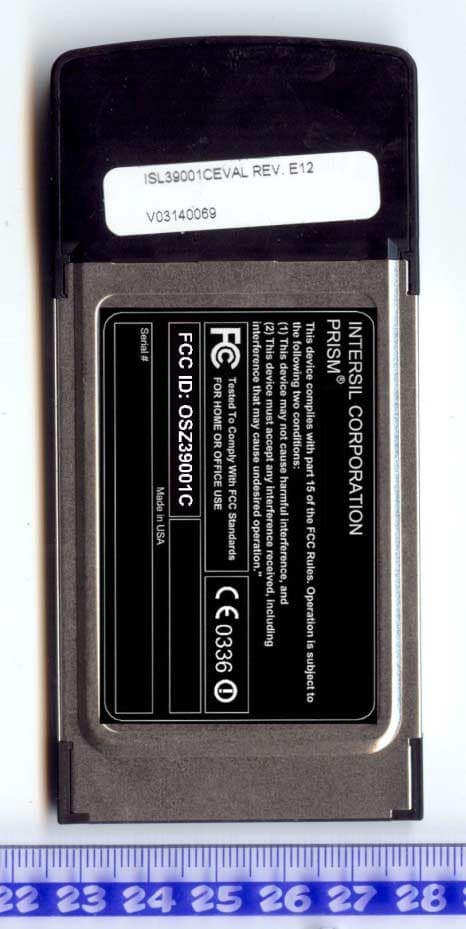
OSZ39001C
Oct 19, 20032.4/5 GHz IEEE 802.11g/a WLAN Cardbus card
Equipment Class
DTS - Digital Transmission System
OSZ39000M1
Aug 20, 20032.4 GHz/5 GHz IEEE 802.11a/g WLAN MiniPCI card
Equipment Class
NII - Unlicensed National Information Infrastructure TX
OSZ37704M
May 26, 20035 GHz IEEE 802.11a WLAN MiniPCI card
Equipment Class
NII - Unlicensed National Information Infrastructure TX