QISF317Fixed Wireless Terminal
Huawei Technologies Co.,Ltd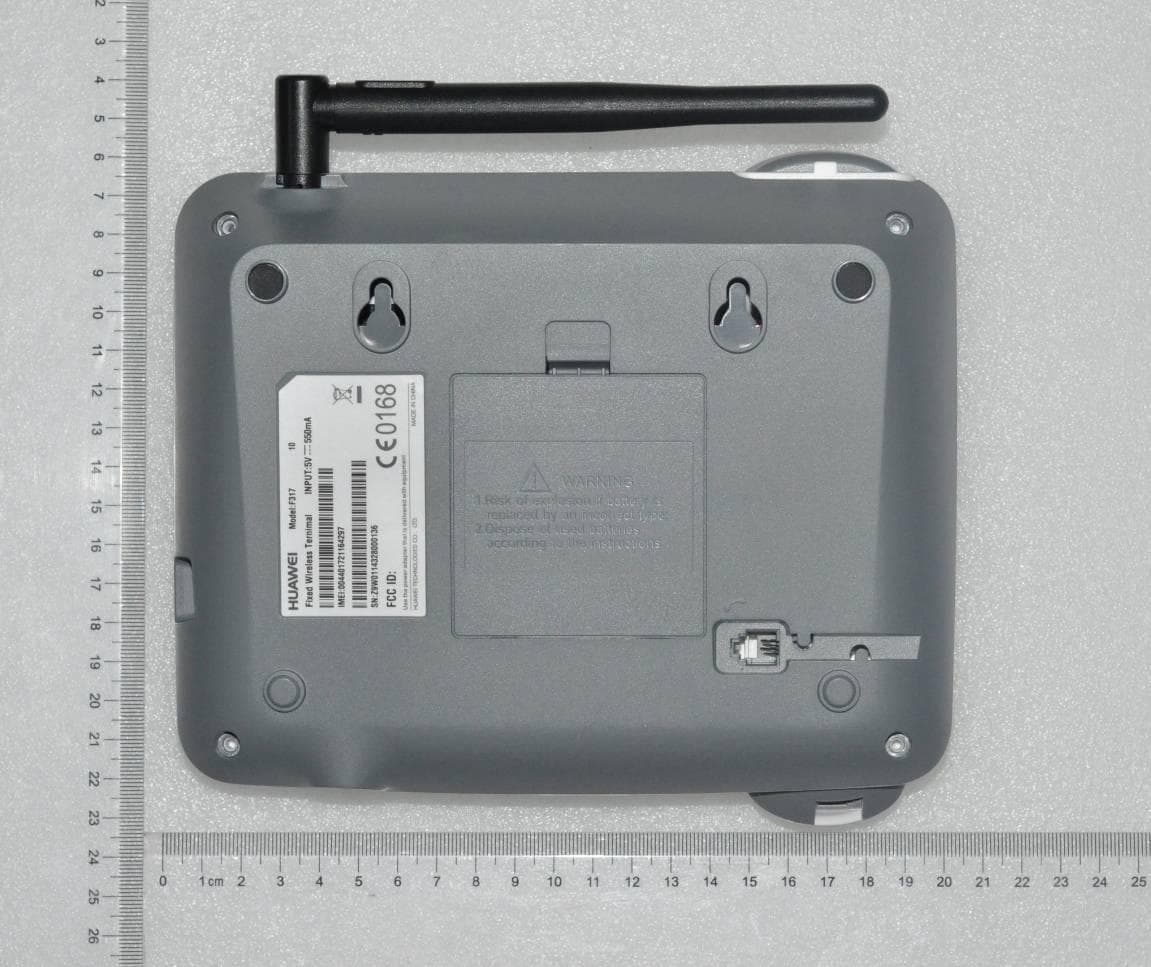
Click to zoom
Application Details
- Equipment Class
- PCB - PCS Licensed Transmitter
- Date of Grant
- May 12, 2014
- Application Purpose
- Original Equipment
- Date of Application
- May 12, 2014
- Equipment Note
- Fixed Wireless Terminal
- Frequency Range
- 1850.20000000 - 1909.80000000
- Company
- Huawei Technologies Co.,Ltd
- Country
- China
Documents & Files
Document Text
Text extracted from the exhibit documents filed with the FCC. Open a document above to read the original.
Users Manual
F317 User Guide 2 1 Getting to know your F317 Front view 1 Left function key Access the main menu in standby mode. Select the option displayed in the lower left corner of the screen. 2 Navigation keys Access the main menu by pressing the OK key in standby mode. Access a shortcut menu by pressing the corresponding navigation key in standby mode. Adjust the volume by pressing the navigation keys during a call. The figures in this guide are provided for your reference only. 3 3 Right function key Select the option displayed in the lower right corner of the screen. 4 Call key Make or answer a call. View the call log in standby mode. 5 End key End or reject a call. Press and hold this key to power the phone on or off. Return to the standby mode. 6 Hands-free key Make or answer a call without lifting the handset in standby mode. In the hands-free mode, cancel the dialing when dialing a number or end the current call. 7 Number and symbol keys Enter numbers, letters, and symbols. Access voicemail by pressing and holding 1 key in standby mode. Speed-dial a user-assigned phone number by pressing and holding 2~9 key in standby mode. Press # key to switch between text input methods in editing mode. Press * key to display the symbol list in editing mode. 4 Back and side view 1 2 3 4 5 6 7 1 Power jack 2 Battery cover 3 Coiled cord jack on main unit 4 SIM card slot 5 Battery container 6 Battery cord jack 7 Wall-mounting brackets 2 Screen icons Full reception Full battery Calling No service Alarm clock Hands-free mode Unread message Unopened voicemail message Powered by the power adapter 5 3 Installation Ensure that F317 is powered off and disconnected from the power adapter. Installing the SIM card Ensure that the golden contacts of the SIM card are facing downward and that the beveled edge of the SIM card is properly aligned with that of the SIM card slot. Then check that the SIM card is fully inserted. Installing the battery Ensure that the battery is correctly installed. Do not frequently remove the SIM card when using F317. 6 Connecting the power adapter When you use F317, it is recommended that you connect the power adapter to F317. 4 Powering on Press and hold until the screen lights up to power on the phone. 5 Calling Making a call 1. In standby mode, press the number keys to enter a phone number. When new phones are delivered, the battery power is low. Therefore, charge the phone for a while and then power on the phone the first time you use it. If the phone will not be used for a long time, remove the battery from the phone. If the battery has not been used for a long time or the battery is exhausted, the screen of F317 may not function when you charge the battery again. This is normal After the battery is being charged for a while, you can power on the phone for use The battery supplies power for only a limited period. Ensure that the battery has been fully charged before putting it in use. Press and hold to power off the phone. 7 2. Press to dial the number. 3. Press to end the call or cancel the dialing. Answering or rejecting a call When there is an incoming call, press to answer the call; press to reject the call. 6 Messages Sending a message 1. Select Messages > Write message. 2. Write the message. 3. Press and then add a recipient using the following methods: – Enter the recipient's phone number. – Add the recipient from the contacts. 4. Press to send the message. Reading a message 1. Select Messages > Inbox. 2. Press / to scroll to a message in the list. 3. Press to open and read the message. You can also use the following methods to dial the number: In standby mode, press to view the call log. Find the desired number in the call log, and then press to dial the number. Find the desired number in the contacts, and then press to dial the number. 8 7 Text input methods Input methods functions The input methods have following basic functions: In editing mode, press the # key to switch between input methods. In editing mode, you can press the right function key to delete the character to the left of the cursor or press and hold the right function key to delete all characters. In predictive and traditional input mode, press the 0 key to enter a space. In any input method, press the * key to display the symbol list. Traditional input In traditional input mode, press the number keys to enter letters. Press a number key repeatedly until the desired character appears. If the next letter you want to enter is on the same key as the current one, wait until the current letter is entered, and then enter the next one. Predictive input 1. Press the keys labeled with the letters required to spell the desired word once according to the spelling sequence of the word. As you enter letters, the phone attempts to predict the desired word and displays candidate words. 2. Press / to scroll to the desired word. 3. Press / to enter the word, or press the 0 key to enter the word followed by a space. Number input In 123 input mode, enter a desired number by pressing the number key. In traditional input mode, press and hold corresponding number key to enter numbers. Press the left function key to manage the message. 9 8 FM FM Radio helps you conveniently listen to the FM radio programs. Select Menu > FM rad io, and then press / to switch the channel. Press / to adjust the volume. You can select Options for more operations. 9 Security Setting the phone lock The phone lock protects your phone from unauthorized use. If you enable phone lock, you will be prompted to enter a phone lock code before you use the phone. Select Settings > Security settings > Phone lock to set the phone lock. You can change the default phone lock code (000000) to a personal password. It is recommended that you periodically change this phone lock code for enhanced security. Setting the keypad lock In standby mode, press and hold # key to lock the keypad. In this case, you can only dial…
Text truncated - open the document above for the full version.
Cover Letter(s)
Huawei Technologies Co.,Ltd Date (04/30/2014) BABT FCB Balfour House, Churchfield Road, Walton-on-Thames, Surrey, KT12 2TD Dear Sir or Madam, We, Huawei Technologies Co., Ltd. Administration Building, Headquarters Shenzhen 518129 China hereby authorize TÜV SÜD Certification and Testing (China) Co., Ltd. Shenzhen Branch Building 12&13, Zhiheng Wisdomland Business Park Nantou Checkpoint Road 2 Nanshan District 518052 Shenzhen P.R.CHINA Felix Li Phone: +86-755-88286998-3243 e-mail: [email protected] to act as our agent in all matters relating to applications for equipment authorization, including the signing of all documents relating to these matters. We also hereby certify that neither we nor any party to this application are subject to denial of U.S. Federal benefits, which include FCC benefits, pursuant to section 5301 of Anti-Drug Abuse Act of 1988, U.S.C. 862 because of conviction for possession or distribution of controlled substance. This authorization is application to following FCC ID application: Model name: F317 FCC ID: QISF317 This authorization is valid until further written notice from Huawei Technologies Co., Ltd. Sincerely, For and Behalf of: Huawei Technologies Co., Ltd. Zhangxinghai EMC Laboratory Manager
Cover Letter(s)
Huawei Technologies Co.,Ltd. Federal Communications Commission 2014-04-30 7435 Oakland Mills Road Columbia MD 21046 Subject: Request for Confidentiality FCC ID: QISF317 To Whom It May Concern: Pursuant to the provisions of Sections 0.457 and 0.459 of the Commission’s rules (47 CFR §§ 0.457, 0.459), we are requesting the Commission to withhold the following attachments as confidential document from public disclosure indefinitely. Schematic Diagram Block Diagram Operational Description Bom List Tune-Up Procedure Above mentioned document contains detailed system and equipment description are considered as proprietary information in operation of the equipment. The public disclosure of above documents might be harmful to our company and would give competitor an unfair advantage in the market. ***************************************************************************** In additional to above mentioned documents, pursuant to Public Notice DA 04-1705 of the Commission’s policy, in order to comply with the marketing regulations in 47 CFR §2.803 and the importation rules in 47 CFR §2.1204, while ensuring that business sensitive information remains confidential until the actual marketing of newly authorized devices. We are requesting the Commission withholds the following documents from public viewing until 2014-6-20 External Photos Internal Photos Test Setup Photos User Manual ****************************************************************************** It is our understanding that all measurement test reports, FCC ID label format and correspondent during certification review process cannot be granted as confidential documents and those information will be available for public review once the grant of equipment authorization is issued. Best Regards Zhang Xinghai EMC Laboratory Manager Huawei Technologies Co., Ltd. E-mail: [email protected] Fax: 0086-0755- 28970299
External Photos
Huawei F317 Fixed Wireless Terminal SECRET Page1, Total6 Photo documentation of external of product Huawei F317 Fixed Wireless Terminal SECRET Page2, Total6 Huawei F317 Fixed Wireless Terminal SECRET Page3, Total6 Huawei F317 Fixed Wireless Terminal SECRET Page4, Total6 Huawei F317 Fixed Wireless Terminal SECRET Page5, Total6 Huawei F317 Fixed Wireless Terminal SECRET Page6, Total6
ID Label/Location Info
Huawei F317 Fixed Wireless Terminal SECRET Page1, Total 1 F317 Label:
ID Label/Location Info
Huawei F317 Fixed Wireless Terminal SECRET Page1, Total 1 F317 Label Location
Internal Photos
Huawei F317 Fixed Wireless Terminal SECRET Page1, Total7 Photo documentation of interior of product Huawei F317 Fixed Wireless Terminal SECRET Page2, Total7 Huawei F317 Fixed Wireless Terminal SECRET Page3, Total7 Huawei F317 Fixed Wireless Terminal SECRET Page4, Total7 Huawei F317 Fixed Wireless Terminal SECRET Page5, Total7 Huawei F317 Fixed Wireless Terminal SECRET Page6, Total7 Huawei F317 Fixed Wireless Terminal SECRET Page7, Total7
RF Exposure Info
Administration Building, Headquarters of Huawei Technologies Co., Ltd., Bantian, Longgang District, Shenzhen, 518129, P.R.C Tel: +86 755 28780808 Fax: +86 755 89652518 FCC SAR Compliance Test Report Product Name: Fixed Wireless Terminal Model: F317 Report No.: SYBH(Z-SAR) 023042014-2 FCC ID: QISF317 APPROVED (Lab Manager) PREPARED (Test Engineer) BY DATE 2014-05-05 2014-05-05 The test results of this test report relate exclusively to the item(s) tested , The HUAWEI does not assume responsibility for any conclusions and generalisations drawn from the test results with regard to other specimens or samples of the type of the equipment represented by the test item. The test report may only be reproduced or published in full. Reproduction or publication of extracts from the report requires the prior written approval of HUAWEI. Reliability Laboratory of Huawei Technologies Co., Ltd. Report No.: SYBH(Z-SAR)023042014-2 FCC ID:QISF317 2014-03-17 Page 2 of 26 Table of Contents 1 General Information ............................................................................................................................................... 4 1.1 Statement of Compliance .............................................................................................................................. 4 1.2 RF exposure limits ......................................................................................................................................... 5 1.3 EUT Description ............................................................................................................................................ 6 1.3.1 General Description ............................................................................................................................... 6 1.3.2 Test position specification ...................................................................................................................... 6 1.4 Test specification(s) ...................................................................................................................................... 7 1.5 Testing laboratory .......................................................................................................................................... 7 1.6 Applicant and Manufacturer .......................................................................................................................... 7 1.7 Application details .......................................................................................................................................... 7 1.8 Ambient Condition ........................................................................................................................................ 7 2 SAR Measurement System ................................................................................................................................. 8 2.1 SAR Measurement Set-up ........................................................................................................................... 8 2.2 Test environment ........................................................................................................................................... 9 2.3 Data Acquisition Electronics description ...................................................................................................... 9 2.4 Probe description ......................................................................................................................................... 10 2.5 Phantom description .................................................................................................................................... 11 2.6 Device holder description ............................................................................................................................ 12 2.7 Test Equipment List ..................................................................................................................................... 13 3 SAR Measurement Procedure .......................................................................................................................... 14 3.1 Scanning procedure .................................................................................................................................... 14 3.2 Spatial Peak SAR Evaluation ...................................................................................................................... 15 3.3 Data Storage and Evaluation ...................................................................................................................... 16 4 System Verification Procedure ............................................................................................................................ 18 4.1 Tissue Verification ....................................................................................................................................... 18 4.2 System Check ............................................................................................................................................. 19 4.3 System check Procedure............................................................................................................................. 20 5 SAR measurement variability and uncertainty .................................................................................................... 21 5.1 SAR measurement variability ...................................................................................................................... 21 5.2 SAR measurement uncertainty ................................................................................................................... 21 6 SAR Test Configuration ...................................................................................................................................... 22 6.1 GSM Test Configuration ............................................................................…
Text truncated - open the document above for the full version.
RF Exposure Info
Report No.: SYBH(Z-SAR) 023042014-2 FCC ID: QISF317 Appendix A. System Check Plots Table of contents SystemPerformanceCheck-D835-ES-Body SystemPerformanceCheck-D1900-ES-Body Date: 2014-4-29 Test Laboratory: HUAWEI SAR/HAC Lab SystemPerformanceCheck-D835-ES-Body DUT: Dipole 835 MHz D835V2; Type: D835V2; Serial: D835V2 - SN:4d059 Communication System: UID 0, CW (0); Frequency: 835 MHz;Duty Cycle: 1:1 Medium parameters used: f = 835 MHz; σ = 0.948 S/m; ε r = 53.435; ρ = 1000 kg/m 3 Phantom section: Flat Section DASY Configuration: lProbe: ES3DV3 - SN3168; ConvF(6.06, 6.06, 6.06); Calibrated: 2013-9-30; lSensor-Surface: 3mm (Mechanical Surface Detection), z = 2.0, 32.0 lElectronics: DAE4 Sn1236; Calibrated: 2013-11-25 lPhantom: SAM1; Type: SAM; Serial: TP-1475 lDASY52 52.8.7(1137); SEMCAD X 14.6.10(7164) Configuration/d=15mm, Pin=250mW/Area Scan (6x15x1): Measurement grid: dx=15mm, dy=15mm Maximum value of SAR (measured) = 2.76 W/kg Configuration/d=15mm, Pin=250mW/Zoom Scan (5x5x7)/Cube 0: Measurement grid: dx=8mm, dy=8mm, dz=5mm Reference Value = 51.570 V/m; Power Drift = 0.03 dB Peak SAR (extrapolated) = 3.51 W/kg SAR(1 g) = 2.4 W/kg; SAR(10 g) = 1.58 W/kg Maximum value of SAR (measured) = 2.81 W/kg 0 dB = 2.81 W/kg = 4.48 dBW/kg Date: 2014-4-29 Test Laboratory: HUAWEI SAR/HAC Lab SystemPerformanceCheck-D1900-ES-Body DUT: Dipole 1900 MHz D1900V2; Type: D1900V2; Serial: D1900V2 - SN:5d143 Communication System: UID 0, CW (0); Frequency: 1900 MHz;Duty Cycle: 1:1 Medium parameters used: f = 1900 MHz; σ = 1.496 S/m; ε r = 52.503; ρ = 1000 kg/m 3 Phantom section: Flat Section DASY Configuration: lProbe: ES3DV3 - SN3168; ConvF(4.72, 4.72, 4.72); Calibrated: 2013-9-30; lSensor-Surface: 3mm (Mechanical Surface Detection), z = 2.0, 32.0 lElectronics: DAE4 Sn1236; Calibrated: 2013-11-25 lPhantom: SAM2; Type: SAM; Serial: TP:1474 lDASY52 52.8.7(1137); SEMCAD X 14.6.10(7164) Configuration/d=10mm, Pin=250mW/Area Scan (6x9x1): Measurement grid: dx=15mm, dy=15mm Maximum value of SAR (measured) = 8.61 W/kg Configuration/d=10mm, Pin=250mW/Zoom Scan (5x5x7)/Cube 0: Measurement grid: dx=8mm, dy=8mm, dz=5mm Reference Value = 89.655 V/m; Power Drift = -0.03 dB Peak SAR (extrapolated) = 17.7 W/kg SAR(1 g) = 10.2 W/kg; SAR(10 g) = 5.34 W/kg Maximum value of SAR (measured) = 12.7 W/kg 0 dB = 12.7 W/kg = 11.05 dBW/kg
RF Exposure Info
Report No.: SYBH(Z-SAR) 023042014-2 FCC ID: QISF317 Appendix B. SAR Measurement Plots Table of contents GSM850 B ody GSM1900 B ody Date: 2014-4- 29 Test Laboratory: HUAWEI SAR/HAC Lab F317 GSM850 251CH Top side 25mm-antenna horizontal DUT: F317; Type: Fixed Wireless Terminal; Serial: SAR1 Communication System: UID 0, HW-GSM\GPRS\EGPRS-1TS (0); Frequency: 848.8 MHz;Duty Cycle: 1:8.30042 Medium parameters used: f = 849 MHz; σ = 0.947 S/m; ε r = 52.728; ρ = 1000 kg/m 3 Phantom section: Flat Section DASY Configuration: lProbe: ES3DV3 - SN3168; ConvF(6.06, 6.06, 6.06); Calibrated: 2013-9- 30; lSensor-Surface: 3mm (Mechanical Surface Detection), z = 2.0, 32.0 lElectronics: DAE4 Sn1236; Calibrated: 2013-11- 25 lPhantom: SAM1; Type: SAM; Serial: TP-1475 lDASY52 52.8.7(1137); SEMCAD X 14.6.10(7164) Configuration/Body/Area Scan (7x15x1): Measurement grid: dx=15mm, dy=15mm Maximum value of SAR (measured) = 0.647 W/kg Configuration/Body/Zoom Scan (5x5x7)/Cube 0: Measurement grid: dx=8mm, dy=8mm, dz=5mm Reference Value = 25.567 V/m; Power Drift = -0.01 dB Peak SAR (extrapolated) = 0.792 W/kg SAR(1 g) = 0.590 W/kg; SAR(10 g) = 0.419 W/kg Maximum value of SAR (measured) = 0.668 W/kg 0 dB = 0.668 W/kg = -1.75 dBW/kg Date: 2014-4- 29 Test Laboratory: HUAWEI SAR/HAC Lab F317 GSM1900 661CH Top side 25mm-antenna vertical with battery 3# DUT: F317; Type: Fixed Wireless Terminal; Serial: SAR1 Communication System: UID 0, HW-GSM\GPRS\EGPRS-1TS (0); Frequency: 1880 MHz;Duty Cycle: 1:8.30042 Medium parameters used: f = 1880 MHz; σ = 1.484 S/m; ε r = 52.607; ρ = 1000 kg/m 3 Phantom section: Flat Section DASY Configuration: lProbe: ES3DV3 - SN3168; ConvF(4.72, 4.72, 4.72); Calibrated: 2013-9- 30; lSensor-Surface: 3mm (Mechanical Surface Detection), z = 2.0, 32.0 lElectronics: DAE4 Sn1236; Calibrated: 2013-11- 25 lPhantom: SAM2; Type: SAM; Serial: TP:1474 lDASY52 52.8.7(1137); SEMCAD X 14.6.10(7164) Configuration/Body/Area Scan (7x15x1): Measurement grid: dx=15mm, dy=15mm Maximum value of SAR (measured) = 0.233 W/kg Configuration/Body/Zoom Scan (5x5x7)/Cube 0: Measurement grid: dx=8mm, dy=8mm, dz=5mm Reference Value = 5.069 V/m; Power Drift = 0.07 dB Peak SAR (extrapolated) = 0.301 W/kg SAR(1 g) = 0.198 W/kg; SAR(10 g) = 0.124 W/kg Maximum value of SAR (measured) = 0.234 W/kg 0 dB = 0.234 W/kg = -6.30 dBW/kg
RF Exposure Info
Justification of the extended calibration of Dipole D835V2 SN:4d059 Per KDB 865664, we have Measured the Impedance and Return Loss as below, and the return loss is <-20dB, with 20% of prior calibration; the real or imaginary parts of the impedance is with 5 ohm of prior calibration. Therefore the verification result should support extended calibration. Dipole2300 Head TST Target Value Measured Value Difference Impedance transformed to feed point 51.7Ω-2.7jΩ 50.43Ω-2.79jΩ R=-1.27Ω, X=-0.09Ω Return Loss -30.2dB -30.16dB 0.13% Dipole2300 Body TST Target Value Measured Value Difference Impedance transformed to feed point 47.1Ω-4.7jΩ 46.74Ω-4.96jΩ R=-0.36Ω, X=-0.26Ω Return Loss -24.9dB -24.63dB 1.08% Measured Date 2013-05-02 2014-05-01 ----- Impedance Test-Head Return Loss Test-Head
RF Exposure Info
Justification of the extended calibration of Dipole D1900V2 SN: 5d143 Per KDB 865664, we have Measured the Impedance and Return Loss as below, and the return loss is <-20dB, with 20% of prior calibration; the real or imaginary parts of the impedance is with 5 ohm of prior calibration. Therefore the verification result should support extended calibration. Dipole1900 Head TST Target Value Measured Value Difference Impedance transformed to feed point 53.5Ω+5.8jΩ 53.26Ω+5.99jΩ R=-0.24Ω, X=0.19Ω Return Loss -23.7dB -25.10dB -5.91% Dipole1900 Body TST Target Value Measured Value Difference Impedance transformed to feed point 48.4Ω+6.1jΩ 50.44Ω+6.40jΩ R=2.04Ω, X=0.3Ω Return Loss -23.9dB -24.91dB -4.23% Measured Date 2011-09-26 2013-09-12 ----- Impedance Test-Head Return Loss Test-Head Impedance Test-Body Return Loss Test-Body
Test Report
RF Test Report of HUAWEI Y330-U17, Y330-U17 FCC ID: QISY330-U17, Report No: SYBH(Z-RF)015032014-2001 Huawei Proprietary and Confidential Copyright © Huawei Technologies Co., Ltd. Page 1 of 45 Appendix for test report RF Test Report of HUAWEI Y330-U17, Y330-U17 FCC ID: QISY330-U17, Report No: SYBH(Z-RF)015032014-2001 Huawei Proprietary and Confidential Copyright © Huawei Technologies Co., Ltd. Page 2 of 45 1Appendix_A: Effective (Isotropic) Radiated Power Output Data Part I - Test Results Test Band Test Mode Test Channel Measured[dBm ] ERP(EIRP)[dBm] Limit [dBm] Verdict GSM850 GSM/TM1 LCH 32.20 31.05 38.5 PASS MCH 32.29 31.14 38.5 PASS HCH 32.27 31.12 38.5 PASS GSM1900 GSM/TM1 LCH 29.67 30.67 33 PASS MCH 29.92 30.92 33 PASS HCH 29.97 30.97 33 PASS Note1: a, For getting the ERP (Efficient Radiated Power) or EIRP (Efficient Isotropic Radiated Power) in substitution method, the following formula should be taken to calculate it, ERP [dBm] = SGP [dBm] - Cable Loss [dB] + Gain [dBd] EIRP [dBm] = SGP [dBm] - Cable Loss [dB] + Gain [dBi] b, SGP=Signal Generator Level Note2: RBW > emission bandwidth, VBW > 3 x RBW. Detector: RMS RF Test Report of HUAWEI Y330-U17, Y330-U17 FCC ID: QISY330-U17, Report No: SYBH(Z-RF)015032014-2001 Huawei Proprietary and Confidential Copyright © Huawei Technologies Co., Ltd. Page 3 of 45 2Appendix_B: Peak-to-Average Ratio Part I - Test Results Test Band Test Mode Test Channel Measured[dB] Limit [dB] Verdict GSM850 GSM/TM1 LCH 0.56 13 PASS MCH 0.41 13 PASS HCH 0.64 13 PASS GSM1900 GSM/TM1 LCH 0.28 13 PASS MCH 0.33 13 PASS HCH 0.34 13 PASS RF Test Report of HUAWEI Y330-U17, Y330-U17 FCC ID: QISY330-U17, Report No: SYBH(Z-RF)015032014-2001 Huawei Proprietary and Confidential Copyright © Huawei Technologies Co., Ltd. Page 4 of 45 3Appendix_C: Modulation Characteristics Part I - Test Plots 3.1 For GSM 3.1.1 Test Band = GSM850 3.1.1.1 Test Mode = GSM/TM1 3.1.1.1.1 Test Channel = MCH RF Test Report of HUAWEI Y330-U17, Y330-U17 FCC ID: QISY330-U17, Report No: SYBH(Z-RF)015032014-2001 Huawei Proprietary and Confidential Copyright © Huawei Technologies Co., Ltd. Page 5 of 45 3.1.2 Test Band = GSM1900 3.1.2.1 Test Mode = GSM/TM1 3.1.2.1.1 Test Channel = MCH RF Test Report of HUAWEI Y330-U17, Y330-U17 FCC ID: QISY330-U17, Report No: SYBH(Z-RF)015032014-2001 Huawei Proprietary and Confidential Copyright © Huawei Technologies Co., Ltd. Page 6 of 45 4Appendix_D: Bandwidth Part I - Test Results Test Band Test Mode Test Channel Occupied Bandwidth [kHz] Emission Bandwidth [kHz] Verdict GSM850 GSM/TM1 LCH 245.44 322.6 Pass MCH 249.22 313.2 Pass HCH 246.20 315.6 Pass GSM1900 GSM/TM1 LCH 244.55 316.1 Pass MCH 245.34 318.3 Pass HCH 249.62 321.0 Pass RF Test Report of HUAWEI Y330-U17, Y330-U17 FCC ID: QISY330-U17, Report No: SYBH(Z-RF)015032014-2001 Huawei Proprietary and Confidential Copyright © Huawei Technologies Co., Ltd. Page 7 of 45 Part II - Test Plots 4.1 For GSM 4.1.1 Test Band = GSM850 4.1.1.1 Test Mode = GSM/TM1 4.1.1.1.1 Test Channel = LCH RF Test Report of HUAWEI Y330-U17, Y330-U17 FCC ID: QISY330-U17, Report No: SYBH(Z-RF)015032014-2001 Huawei Proprietary and Confidential Copyright © Huawei Technologies Co., Ltd. Page 8 of 45 4.1.1.1.2 Test Channel = MCH RF Test Report of HUAWEI Y330-U17, Y330-U17 FCC ID: QISY330-U17, Report No: SYBH(Z-RF)015032014-2001 Huawei Proprietary and Confidential Copyright © Huawei Technologies Co., Ltd. Page 9 of 45 4.1.1.1.3 Test Channel = HCH RF Test Report of HUAWEI Y330-U17, Y330-U17 FCC ID: QISY330-U17, Report No: SYBH(Z-RF)015032014-2001 Huawei Proprietary and Confidential Copyright © Huawei Technologies Co., Ltd. Page 10 of 45 4.1.2 Test Band = GSM1900 4.1.2.1 Test Mode = GSM/TM1 4.1.2.1.1 Test Channel = LCH RF Test Report of HUAWEI Y330-U17, Y330-U17 FCC ID: QISY330-U17, Report No: SYBH(Z-RF)015032014-2001 Huawei Proprietary and Confidential Copyright © Huawei Technologies Co., Ltd. Page 11 of 45 4.1.2.1.2 Test Channel = MCH RF Test Report of HUAWEI Y330-U17, Y330-U17 FCC ID: QISY330-U17, Report No: SYBH(Z-RF)015032014-2001 Huawei Proprietary and Confidential Copyright © Huawei Technologies Co., Ltd. Page 12 of 45 4.1.2.1.3 Test Channel = HCH RF Test Report of HUAWEI Y330-U17, Y330-U17 FCC ID: QISY330-U17, Report No: SYBH(Z-RF)015032014-2001 Huawei Proprietary and Confidential Copyright © Huawei Technologies Co., Ltd. Page 13 of 45 5Appendix_E: Band Edges Compliance Part I - Test Plots 5.1 For GSM 5.1.1 Test Band = GSM850 5.1.1.1 Test Mode = GSM/TM1 5.1.1.1.1 Test Channel = LCH RF Test Report of HUAWEI Y330-U17, Y330-U17 FCC ID: QISY330-U17, Report No: SYBH(Z-RF)015032014-2001 Huawei Proprietary and Confidential Copyright © Huawei Technologies Co., Ltd. Page 14 of 45 5.1.1.1.2 Test Channel = HCH RF Test Report of HUAWEI Y330-U17, Y330-U17 FCC ID: QISY330-U17, Report No: SYBH(Z-RF)015032014-2001 Huawei Proprietary and Confidential Copyright © Huawei Technologies Co., Ltd. Page 15 of 45 5.1.2 Test Band = GSM1900 5.1.2.1 Test Mode = GSM/TM1 5.1.2.1.1 Test Channel = LCH RF Test Report of HUAWEI Y330-U17, Y330-U17 FCC ID: QISY330-U17, Report No: SYBH(Z-RF)015032014-2001 Huawei Proprietary and Confidential Copyright © Huawei Technologies Co., Ltd. Page 16 of 45 5.1.2.1.2 Test Channel = HCH RF Test Report of HUAWEI Y330-U17, Y330-U17 FCC ID: QISY330-U17, Report No: SYBH(Z-RF)015032014-2001 Huawei Proprietary and Confidential Copyright © Huawei Technologies Co., Ltd. Page 17 of 45 6Appendix_F: Spurious Emission at Antenna Terminal NOTE: For the averaged unwanted emissions measurements, the measurement points in each sweep is greater than twice the Span/RBW in order to ensure bin-to-bin spacing of < RBW/2 so that narrowband signals are not lost between frequency bins. As to the present test item, the "Measurement Points = k * (Span / RBW)" with k between 4 and 5, which results in an acceptable level error of less than 0.5 dB. Part I - Test Plots 6.1 For GSM 6.1.1 Test Band = GSM850 6.1.1.1 Test Mode = GSM/TM1 6.1.1.1.1 Test Channel = LCH RF Test Repor…
Text truncated - open the document above for the full version.
Test Setup Photos
RF Test Report of F317 Huawei Proprietary and Confidential Copyright © Huawei Technologies Co., Ltd. Page 1 of 3 Photos of Test Setup RF Test Report of F317 Huawei Proprietary and Confidential Copyright © Huawei Technologies Co., Ltd. Page 2 of 3 1 Radiated Spurious Emissions Radiated Spurious Emission (below 1GHz) Radiated Spurious Emission (1GHz to18GHz) RF Test Report of F317 Huawei Proprietary and Confidential Copyright © Huawei Technologies Co., Ltd. Page 3 of 3 Radiated Spurious Emission (above 18GHz) ---------------------------------------------------------------END--------------------------------------------------------------
Test Setup Photos
Report No.: SYBH(Z-SAR) 023042014-2 FCC ID: QISF317 Appendix D. Photo documentation Table of contents Test Facility Test Positions Liquid depth Test Facility Photo 1: Measurement System DASY5 Test Positions Photo 2: Front View Photo 3: Rear View Photo 4: Back side antenna horizontal (25mm) Photo 5: Back side antenna vertical (25mm) Photo 6: Top side antenna horizontal (25mm) Photo 7: Top side antenna vertical (25mm) Liquid depth Photo 8:MSL 835MHz depth (15.2cm) Photo 9:MSL 1900MHz depth (15.1cm)
Contact Information
Applicant
Zhang Xinghai
Test Firm
Huawei Technologies Co., LTDZhou Fengyum
Technical Specifications
| # | Rule Parts | Frequency Range | Power Output | Emission | Tolerance |
|---|---|---|---|---|---|
| 2 | 24E | 1.85 GHz - 1.91 GHz | 1.25 W | 250KGXW | 22.6 Hz |
Other Applications from Huawei Technologies Co.,Ltd
QISSUN2000
Jun 27, 2021Solar Inverter
Equipment Class
DTS - Digital Transmission System
QISCP81-1
Oct 22, 2020Watch Wireless Charger
Equipment Class
DCD - Part 15 Low Power Transmitter Below 1705 kHz
QISRRU3278
Sep 02, 2020Remote Radio Unit
Equipment Class
CBD - Citizens Band Category A and B Devices
QISR2561
Jul 11, 2020Indoor Router
Equipment Class
DTS - Digital Transmission System
QISSMARTLOGGER310
Mar 23, 2020Solar Smart Monitor & Data Logger
Equipment Class
DTS - Digital Transmission System