QISK3520HSDPA USB Stick
Huawei Technologies Co.,Ltd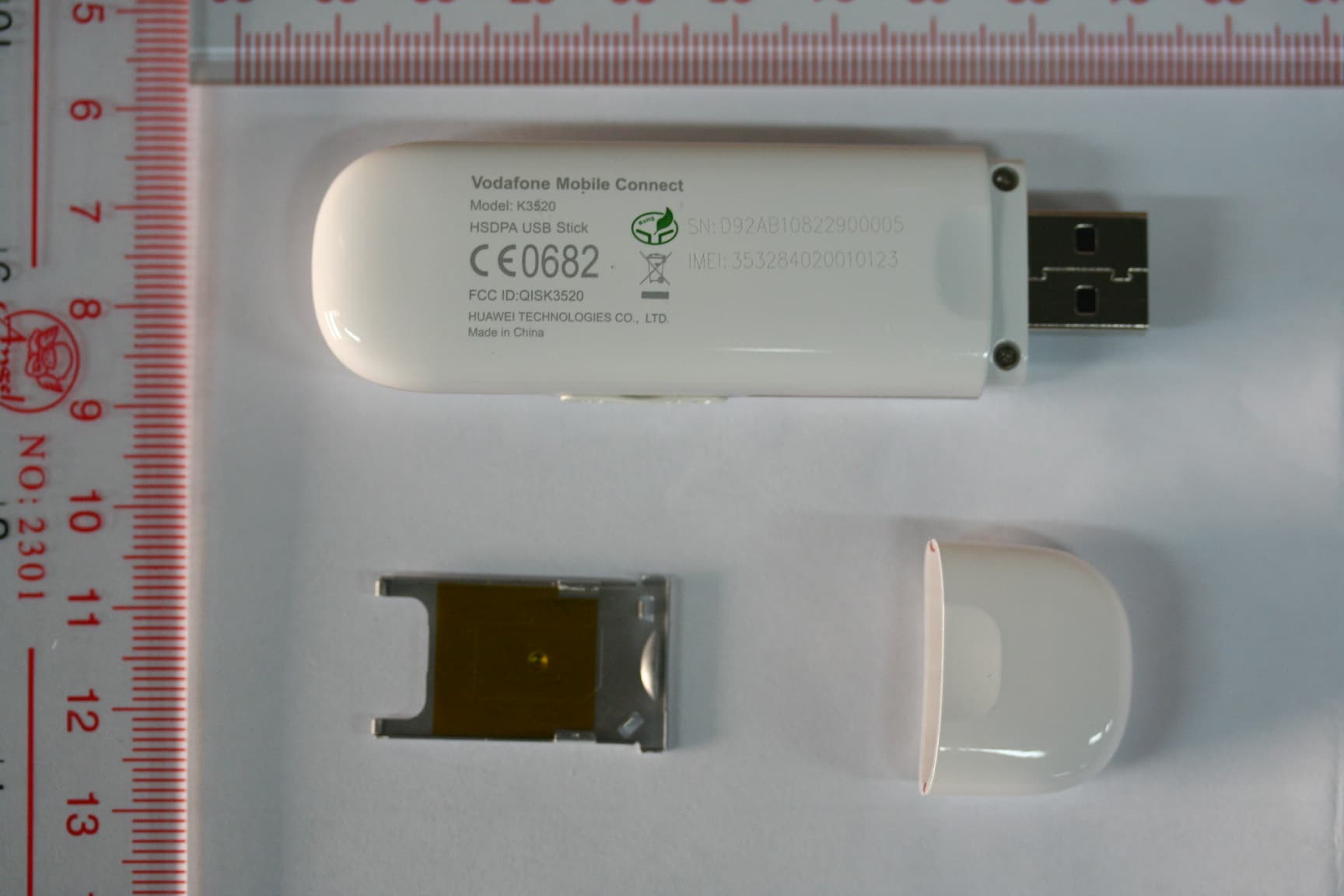
Click to zoom
Application Details
- Equipment Class
- PCB - PCS Licensed Transmitter
- Date of Grant
- Apr 07, 2008
- Application Purpose
- Original Equipment
- Date of Application
- Apr 07, 2008
- Equipment Note
- HSDPA USB Stick
- Frequency Range
- 1850.20000000 - 1909.80000000
- Company
- Huawei Technologies Co.,Ltd
- Country
- China
Documents & Files
Document Text
Text extracted from the exhibit documents filed with the FCC. Open a document above to read the original.
Users Manual
Quick Start Guide Vodafone Mobile Connect USB Stick Welcome to the world of mobile communications 1Welcome 2Set up your USB Stick 3Start the software 4Software overview 5Connect 6SMS text messaging 7SMS contacts 9USB Stick LED light 9Signal strength 10Hints and tips 12Glossary 1 Yo u r n e w Vodafone Mobile Connect USB Stick lets you connect your computer to the internet over the Vodafone high-speed mobile phone network. Browse the web You can now access the web and any other internet ser vice wherever there’s a mobile phone network . Pick up emails Keep up to date with your emails, wherever you are. You can also access your personal email accounts – even web-based accounts like Hotmail. Send and receive SMS text messages* You can send and receive SMS text messages straight from your computer. Vodafone SMS provides an easy way to view messages, write new ones, and manage contact details. System Requirements To use this USB Stick and the Vodafone Mobile Connect software, you need: – A computer running Microsoft ® Windows Vista ™ , Windows ® XP or Windows ® 2000, or an Apple Mac running Mac OS ® X 10.3.9 or above – At least 50 MB free disk space and 256 MB RAM memory – A USB 2.0 socket – Administrator rights on your computer. Welcome * SMS is currently only supported on computers running Microsoft Windows. 2 • Remove the cap from the end of the USB Stick. Pull out the SIM holder from its slot, and insert your SIM as shown. • Re-insert the SIM holder into the USB Stick. • If you are using a MicroSD memory card with your Stick (to allow your Stick to behave as a fl ash memory drive), insert the card as shown. • Plug the USB Stick fi rmly into your computer’s USB port. Set up your USB Stick Your SIM (Subscriber Identity Module is the small, postage-stamp-sized chip that you received together with your mobile subscriber contract. 3 On Microsoft Windows computers The software setup should start automatically, and proceed to set up your USB Stick. If for some reason the setup does not start, double-click the fi le called setup.exe on the USB Stick. Follow the on-screen instructions. Setting up your USB Stick may take a few minutes, but once the setup is fi nished, the Vodafone Mobile Connect Lite software should start automatically. If for some reason the program does not start, select Vodafone Mobile Connect Lite from the Windows Start menu. On Mac OS X computers The fi rst time you plug in your USB Stick, it will show up on your desktop like a standard USB memory stick. From the USB Stick window, double-click the fi le called Vodafone MC Installer , and follow the on-screen instructions. Once your Mac has restarted, the USB Stick will no longer appear, but you will see the Vodafone Mobile Connect software in your Applications folder. Double-click the program to set up a mobile connection. Start the software Connect/Disconnect Connect via the mobile phone network Views View data usage, and additional software settings Start SMS program Send, receive and manage SMS messages and contacts Status Check the status of your connection Help Help Topics, plus internet and hotline support. 4 Software overview 5 1 4 2 3 2 1 5 3 4 The first time you run the software, your USB Stick will usually be set as the default device. If it is not, click ‘Manage Devices’ and select your USB Stick there. 5 The radio waves on the Mobile Connections icon are animated whenever data is being transferred over the connection. No radio waves are shown when nothing is being transferred. The radio waves are shown static when no connection is open. If a mobile network has been found, the Connect button in the Mobile Connections panel will be enabled. Clicking Connect connects to the internet across the mobile phone network. Now you can browse the web or use email. When connected, the Connect button text changes to Disconnect and a green ‘Connected’ indicator appears below the button. Clicking the Disconnect button will close the connection – and the text on the button will revert to Connect. To open a mobile connection, you need to be within coverage of a mobile network. As a rule, anywhere you can make a call on your mobile phone, you should be able connect. Connect 6 Click Vodafone SMS on the navigation bar in the main window of the Vodafone Mobile Connect Lite software to open the SMS program. To send an SMS Click New at the left-hand end of the SMS toolbar to create a new SMS text message. Address Enter the recipients here, or choose them from Contacts Message Write your message here Send Click on the Send button to send your message. After your SMS has been sent, it will be stored in the Sent list. SMS Text Messaging 2 1 3 The number displayed to the person who receives your message will be from your data SIM, not your mobile phone. Use a short ‘signature’ to make sure people know you sent them a message: Settings/ Messages/Signature. 2 1 3 7 Receiving SMS When you receive a new message, an SMS Notifi cation is shown briefl y so you can respond to it directly. The received message can also be read from the Inbox in the main Vodafone SMS window. The Vodafone SMS software will receive text messages whenever you have mobile network coverage. 8 SMS Contacts Click Contacts on the SMS navigation bar to open the Contacts list, in which you can save SMS numbers that you use frequently as contacts with names. New SMS Contact Clicking the New button on the SMS toolbar opens a new contact window. Enter the name and number of your contact using the international format for the number, eg. +447774477000. 9 USB Stick LED light Signal strength The LED light on your USB Stick shows which kind of mobile network has been found, and whether the USB Stick is connected to that network. Green blinking A GPRS network has been found – you could connect Green solid Connected via GPRS Blue blinking A 3G network has been found – you could connect Blue solid Connected via 3G Light blue solid Connected via 3G Broadband. The strength of the mobile netw…
Text truncated - open the document above for the full version.
Cover Letter(s)
Huawei Technologies Co., Ltd. Federal Communication Commission Equipment Authorization Division, Application Processing Branch 7435 Oakland Mills Road Columbia, MD 21048 2008-04-04 TO WHOM IT MAY CONCERN FCC ID: QISK3520, Model: K3520 Modifications: E169 is a GSM/GPRS/EDGE/WCDMA/HSDPA USB Stick.。The GSM supports four bands. The WCDMA supports W2100M and W900M. K3520 is the USB stick which changed some component from E169. The PCB are the same. The followed table is show the different between the K3520 and the E169. E169 K3520 GSM four band support support WCDMA 2100M support support WCDMA 900M support support 64M FLASH support 128M FLASH support PCB the same the same antenna the same the same ID Common ID, supports the external interface and the TF interface Vodafone ID, supports the external interface and the TF interface The size of the shell 87.8×24.8× 12.12 87.7×25.7×12.2 PDF 文件使用 "pdfFactory Pro" 试用版本创建 www.fineprint.cn The photo of the sticks: E169 K3520 Sincerely, Zhang Xinghai EMC Laboratory Manager For and Behalf of: Huawei Technologies Co., Ltd. Huawei Industrial Base, Bantian, Longgang, Shenzhen, P.R China 0086-755-89651014 PDF 文件使用 "pdfFactory Pro" 试用版本创建 www.fineprint.cn
Cover Letter(s)
Huawei Technologies Co., Ltd. Address:Huawei Industrial Base,Bantian Longgang,Shenzhen 518129, P.R China Post ZIP:518129 Page :1/1 To: CETECOM Fax : NULL From:Zhang Xinghai Fax:0086-755-89652518 Tel:0086-755-89651014 Email address: [email protected] Http: www.huawei.com Subject:Letter of Confidentiality Federal Communications Commission 7435 Oakland Mills Road Columbia, MD 21046 Gentlemen: This letter is to comply with the Code of Federal Regulations Title 47 Section 0.457 and 0.459 pertaining to confidential material. Huawei Technologies Co., Ltd. would like the following documents regarding this submission for FCC ID: QISK3520 to be kept confidential: 1. Schematic diagram . 2. Block Diagram. 3. Parts list (BOM) Information. 4. Operational description. 5. Ture-up procedure The above material contains trade secrets or technical data, which would customarily be guarded from competitors. We do not want these documents to be accessible to the general public. Sincerely, For and Behalf of: Huawei Technologies Co., Ltd. Zhang Xinghai EMC Laboratory Manager
Cover Letter(s)
Huawei Technologies Co., Ltd. Administration Building, Huawei Base, Bantian, Longgang District, Shenzhen 518129 P.R.C. +86 755 28780808 www.huawei.com Huawei internal reference RCT-US-01-01 USA FCC Short Term Confidentiality Request template Effective date: 2007-01-06 Version 1.1 Short Term Confidentiality Request 2008-03-18 Federal Communications Commission Office of Engineering and Technology Equipment Authorization Division 7345 Oakland Mills Road Columbia, Maryland 21046 Subject: SHORT-TERM Confidentiality Request for FCC ID: QISK3520 Product Name: HSDPA USB Stick Product Model: K3520 To whom maybe concern: Pursuant to sections 0.457 and 0.459 of CFR 47 and to avoid premature release of sensitive information prior to marketing or release of the product to the public, Huawei Technologies Co., Ltd requests the following documents contained in this certification application be temporarily withheld from public disclosure for an initial period of 90 days: 1. External Photos 2. Internal Photos 3. Test Setup Photos 4. Users Manual The applicant also acknowledges that they will also provide appropriate notice to CETECOM should either of the following occur: A) If the applicant requires additional 45 day extension periods they will notify CETECOM with a new request letter at least 7 days prior to the short-term confidentiality expiration date-[Note: up to maximum of 3 extensions only are allowed], or b) Immediately notify CETECOM in the event the information regarding the product of the product is made available to the public. CETECOM will then release the documents listed above for public disclosure pursuant to FCC Public Notice DA 04-1705. Sincerely,
External Photos
K3520 SECRET Page1,Total 6 External Photos of K3520 K3520 SECRET Page2,Total 6 K3520 SECRET Page3,Total 6 K3520 SECRET Page4,Total 6 K3520 SECRET Page5,Total 6 K3520 SECRET Page6,Total 6
External Photos
K3520 SECRET Page1,Total 6 External Photos of K3520 K3520 SECRET Page2,Total 6 K3520 SECRET Page3,Total 6 K3520 SECRET Page4,Total 6 K3520 SECRET Page5,Total 6 K3520 SECRET Page6,Total 6
ID Label/Location Info
K3520 SECRET Page1, Total 1 ID Label K3520
ID Label/Location Info
K3520 SECRET Page1, Total 1 ID Label Location K3520
ID Label/Location Info
K3520 SECRET Page1, Total 1 ID Label K3520
ID Label/Location Info
K3520 SECRET Page1, Total 1 ID Label Location K3520
Internal Photos
K3520 SECRET Page1,Total 6 Internal Photos of K3520 K3520 SECRET Page2,Total 6 K3520 SECRET Page3,Total 6 K3520 SECRET Page4,Total 6 K3520 SECRET Page5,Total 6 K3520 SECRET Page6,Total 6
RF Exposure Info
NO.: RZA2008-0235FCC OET 65 TEST REPORT Test name Electromagnetic Field (Specific Absorption Rate) Product HSDPA USB Stick Model K3520 FCC ID QISK3520 Client HUAWEI Technologies Co., Ltd. TA Technology (Shanghai) Co., Ltd. TA Technology (Shanghai) Co., Ltd. Test Report No. RZA2008-0235FCC Page 2of 122 GENERAL TERMS 1. The test report is invalid if not marked with “exclusive stamp for the data report” or the stamp of the TA. 2. Any copy of the test report is invalid if not re-marked with the “exclusive stamp for the test report” or the stamp of TA. 3. The test report is invalid if not marked with the stamps or the signatures of the persons responsible for performing, revising and approving the test report. 4. The test report is invalid if there is any evidence of erasure and/or falsification. 5. If there is any dissidence for the test report, please file objection to the test center with in 15 days from the date of receiving the test report. 6. Normally, entrust test is only responsible for the samples that have undergone the test. 7. This test report cannot be used partially or in full for publicity and/or promotional purposes with out previous written permissions of TA. Address: Room4,No.399,Cailun Rd,Zhangjiang Hi-Tech Park, Pudong Shanghai,China Post code: 201203 Telephone: +86-021-50791141/2/3 Fax:+86-021-50791147 Website: http://www.ta-shanghai.com E-mail: [email protected] TA Technology (Shanghai) Co., Ltd. Test Report No. RZA2008-0235FCC Page 3of 122 GENERAL SUMMARY Product HSDPA USB Stick Model K3520 Client HUAWEI Technologies Co., Ltd. Type of test Entrusted Manufacturer HUAWEI Technologies Co., Ltd. Arrival Date of sample Mar.1 st , 2008 Place of sampling (Blank) Carrier of the samples Ting Zhang Quantity of the samples One Date of product (Blank) Base of the samples (Blank) Items of test SAR Series number EV7NAA17A2712292 Standard(s) EN 50360–2001: Product standard for the measurement of Specific Absorption Rate related to human exposure to electromagnetic fields from mobile phones. EN 50361–2001: Basic standard for the measurement of Specific Absorption Rate related to human exposure to electromagnetic fields from mobile phones. ANSI C95.1–1999: IEEE Standard for Safety Levels with Respect to Human Exposure to Radio Frequency Electromagnetic Fields, 3 kHz to 300 GHz IEEE 1528–2003: Recommended Practice for Determining the Peak Spatial-Average Specific Absorption Rate (SAR) in the Human Body Due to Wireless Communications Devices: Experimental Techniques. OET65C revision2002 DA 09-1948, June 19.2002:Additional Information for Evaluating Compliance of Mobile and Portable Devices with FCC Limits. IEC 62209-2 (Draft): Human exposure to radio frequency fields from hand-held and body-mounted wireless communication devices – Human models, instrumentation, and procedures –Part 2: Procedure to determine the Specific Absorption Rate (SAR)in the head and body for 30MHz to 6GHz Handheld and Body-Mounted Devices used in close proximity to the body. Vodafone SAR_Data_cards_V1.1: Global Test Specification for Terminals for Performance Measurements –Performance TST- Specific Absorption Rate (SAR) for Data Cards and External Antennas. Conclusion Localized Specific Absorption Rate (SAR) of this portable wireless equipment has been measured in all cases requested by the relevant standards cited in Clause 6.2 of this test report. Maximum localized SAR is below exposure limits specified in the relevant standards cited in Clause 6.1 of this test report. General Judgment: Pass (Stamp) Date of issue: Mar.10 th .2008 Comment TX Freq. Band: GSM850 GSM1900 Max. Power: 2Watt 1Watt The test result only responds to the measured sample. Approved by chenguang zheng Revised by weizhong yang Performed by minbao ling TA Technology (Shanghai) Co., Ltd. Test Report No. RZA2008-0235FCC Page 4of 122 TABLE OF CONTENT 1. COMPETENCE AND WARRANTIES .................................................................................................................... 6 2. GENERAL CONDITIONS ...................................................................................................................................... 6 3. DESCRIPTION OF EUT ........................................................................................................................................ 7 3.1. ADDRESSING INFORMATION RELATED TO EUT ..............................................................................................7 3.2. CONSTITUENTS OF EUT.................................................................................................................................7 3.3. GENERAL DESCRIPTION.................................................................................................................................7 4. OPERATIONAL CONDITIONS DURING TEST ..................................................................................................... 8 4.1. SCHEMATIC TEST CONFIGURATION................................................................................................................8 4.2. POSITION OF MODULE IN PORTABLE DEVICES.................................................................................................8 4.3. PICTURE OF HOST PRODUCT...........................................................................................................................9 5. SAR MEASUREMENTS SYSTEM CONFIGURATION........................................................................................ 12 5.1. SAR MEASUREMENT SET-UP.......................................................................................................................12 5.2. DASY4 E-FIELD PROBE SYSTEM..................................................................................................................13 5.3. E-FIELD PROBE CALIBRATION......................................................................................................................14 5.4. OTHER TEST EQUIPMENT...........................…
Text truncated - open the document above for the full version.
RF Exposure Info
TA Technology (Shanghai) Co., Ltd. Test Report No. RZA2008-0235FCC Page 101of 122 TA Technology (Shanghai) Co., Ltd. Test Report No. RZA2008-0235FCC Page 102of 122 TA Technology (Shanghai) Co., Ltd. Test Report No. RZA2008-0235FCC Page 103of 122 TA Technology (Shanghai) Co., Ltd. Test Report No. RZA2008-0235FCC Page 104of 122 TA Technology (Shanghai) Co., Ltd. Test Report No. RZA2008-0235FCC Page 105of 122 TA Technology (Shanghai) Co., Ltd. Test Report No. RZA2008-0235FCC Page 106of 122 ANNEX F: D835V2 DIPOLE CALIBRATION CERTIFICATE TA Technology (Shanghai) Co., Ltd. Test Report No. RZA2008-0235FCC Page 107of 122 TA Technology (Shanghai) Co., Ltd. Test Report No. RZA2008-0235FCC Page 108of 122 TA Technology (Shanghai) Co., Ltd. Test Report No. RZA2008-0235FCC Page 109of 122 TA Technology (Shanghai) Co., Ltd. Test Report No. RZA2008-0235FCC Page 110of 122
RF Exposure Info
TA Technology (Shanghai) Co., Ltd. Test Report No. RZA2008-0235FCC Page 111of 122 TA Technology (Shanghai) Co., Ltd. Test Report No. RZA2008-0235FCC Page 112of 122 ANNEX G: D1900V2 DIPOLE CALIBRATION CERTIFICATE TA Technology (Shanghai) Co., Ltd. Test Report No. RZA2008-0235FCC Page 113of 122 TA Technology (Shanghai) Co., Ltd. Test Report No. RZA2008-0235FCC Page 114of 122 TA Technology (Shanghai) Co., Ltd. Test Report No. RZA2008-0235FCC Page 115of 122 TA Technology (Shanghai) Co., Ltd. Test Report No. RZA2008-0235FCC Page 116of 122 TA Technology (Shanghai) Co., Ltd. Test Report No. RZA2008-0235FCC Page 117of 122 TA Technology (Shanghai) Co., Ltd. Test Report No. RZA2008-0235FCC Page 118of 122 TA Technology (Shanghai) Co., Ltd. Test Report No. RZA2008-0235FCC Page 119of 122 TA Technology (Shanghai) Co., Ltd. Test Report No. RZA2008-0235FCC Page 120of 122
RF Exposure Info
K3520 Electromagnetic Radiation Exposure Estimation 1 Maximum Permissible Exposure (MPE) Estimation for K3520 1 Introduction K3520 HSDPA/UMTS/EDGE/GPRS/GSM dual mode 6 BAND USB Stick is subscriber equipment in the UMTS/GSM system. The WCDMA frequency is Band I and Band VIII. The GSM/GPRS/EDGE frequency band includes GSM850, EGSM900, DCS1800 and PCS1900, K3520 implements such functions as RF signal receiving/transmitting, HSDPA/WCDMA and EDGE/GPRS/GSM protocol processing, data service etc. Externally it provides USB interface (to connect to the notebook etc.), USIM card interface and antenna interface. K3520 has an internal antenna as default. 2 Limits and Guidelines on Exposure to Electromagnetic Fields According to the FCC Part 2.1091, we know: mobile device (transmitting device designed to be used in other than fixed locations and to generally be used in such a way that a separation distance of at least 20 centimeters is normally maintained between the transmitters radiating structure(s) and the body of the user or nearby persons). And the Cellular radiotelephone service and PCS services are subject to routine environmental evaluation for RF exposure prior to equipment authorization or use if they operate at frequencies of 1.5 GHz or below and their effective radiated power (ERP) is 1.5 watts or more, or if they operate at frequencies above 1.5 GHz and their ERP is 3 watts or more. The radiated power of 850M/1900M for K3520 is 2W/1W, so for K3520 only the 850M band is need to be subjected to routine the environmental evaluation for RF exposure. Uncontrolled limits are used for general public. General population/uncontrolled exposure apply in situations is which the general public may be exposed, or in which persons that are exposed as a consequence of their employment may not be fully aware of the potential for exposure or can not exercise control over their exposure. The exposure levels can be expressed in terms of power density, electric field strength, or magnetic field strength, as averaged over 30 minutes for the general public and 6 minutes for trained personnel. The exposure criterion is frequency dependent, and a chart covering the range from 3 kHz to 100 GHz can be found in NCRP No.86 (references IEEE C95.1-1999). Below are the limits. Limits for Occupational/Controlled Exposure K3520 Electromagnetic Radiation Exposure Estimation 2 Frequency Range (MHz) Electric Field Strength (E) (V/m) Magnetic Field Strength (H) (A/m) Power Density (S) (mW/cm2) 0.003-0.1 0.1-3.0 3.0-30 30-100 100-300 300-3000 3000-15,000 15,000-100,000 614 614 1842/f 61.4 61.4 -- -- -- 163 16.3/f 16.3/f 16.3/f 0.163 -- -- -- (100)* (100)* (900/f2)* 1.0 1.0 f/300 10 10 Limits for General Population/Uncontrolled Exposure Frequency Range (MHz) Electric Field Strength (E) (V/m) Magnetic Field Strength (H) (A/m) Power Density (S) (mW/cm2) 0.003-0.1 0.1-1.34 1.34-3.0 3.0-30 30-100 100-300 300-3000 3000-15,000 15,000-100,000 614 614 823.8/f 823.8/f 27.5 27.5 -- -- -- 163 16.3/f 16.3/f 16.3/f 158.3 / f1.668 0.0729 -- -- -- (100)* (100)* (180/f2)* ((180/f2)* 0.2 0.2 f/1500 f/1500 10 Power density S [mW/cm2] for controlled area at 850 MHz (TX: 824MHz – 849MHz) 75.2 300 824 300 )( === MHzf S mW/cm 2 Power density S [mW/cm2] for uncontrolled area at 850 MHz 55.0 1500 824 1500 )( === MHzf SmW/cm 2 S= 0.55 mW/ cm 2 = 5.5 W/m 2 for uncontrolled exposure Reference levels are provided for exposure assessment to determine whether the basic restrictions on exposure of humans to electromagnetic fields are exceeded. The basic restrictions on exposure to electromagnetic fields are based directly on established health effects and biological considerations. K3520 Electromagnetic Radiation Exposure Estimation 3 3 Location of EUT The EUT uses one monopole antenna. The source of the radiation is mounted on terminal; generally the direction of the antenna position is uprightness tabletop. The highest level of emission would be expected in close vicinity of the antenna and in line of sight to the antenna. 4 Prediction of the Exposure to Electromagnetic Fields Calculations can be made on a site by site basis to ensure the power density is below the limits given above, or guidelines can be done beforehand to ensure the minimum distances from the antenna is maintained through the site planning. The calculations are based on FCC OET 65 Appendix B. 4.1 Calculation of the Safe Distance Below method describes a theoretical approach to calculate possible exposure to electromagnetic radiation around a base station transceiver antenna. Precise statements are basically only possible either with measurements or complex calculations considering the complexity of the environment (e.g. soil conditions, near buildings and other obstacles) which causes reflections, scattering of electromagnetic fields. The maximum output power (given in EIRP) of a base station is usually limited by license conditions of the network operator. A rough estimation of the expected exposure in power flux density on a given point can be made with the following equation. The calculations are based on FCC OET 65 Appendix B. π∗∗ ∗ = )(4 )( 2 mr GWP S numeric Whereas: P = Maximum output power in W of the site G numeric = Numeric gain of the antenna relative to isotropic antenna R = distance between the antenna and the point of exposure in meters 4.2 Technical Description K3520 Technical Specification: K3520 Electromagnetic Radiation Exposure Estimation 4 Output power: 2W (33 dBm) for GSM850MHz Transmitter frequency band GSM850 Number of antenna ports: 1 Frequency range: 850M Uplink:824 M~849M Downlink:869 M~894M Gain: <1dBi GSM850 Mechanical specification (Height) 19.2mm for GSM850 4.3 Estimation of compliance boundary for indoor antenna GSM 850M: For the final determination of the compliance boundary the model for far-field calculation is used since this overestimates the field strength in the near-field region. Thus the calculated compliance boundary should be rather more conser…
Text truncated - open the document above for the full version.
Test Report
FCC Test Report of K3520 FCC ID: QISK3520 Security Level: Public Report No: SYBH (R) 045012008EB-2 Confidential Information of Huawei. No Distribution without Written Permission Page1, Total3 Appendix A Modulation Characteristics According to FCC Part 2.1047 & Part22 Subpart H FCC Test Report of K3520 FCC ID: QISK3520 Security Level: Public Report No: SYBH (R) 045012008EB-2 Confidential Information of Huawei. No Distribution without Written Permission Page2, Total3 Channel MiddleTM1:GPRS/GSM FCC Test Report of K3520 FCC ID: QISK3520 Security Level: Public Report No: SYBH (R) 045012008EB-2 Confidential Information of Huawei. No Distribution without Written Permission Page3, Total3 Channel MiddleTM2:EDGE
Test Report
FCC Test Report of K3520 FCC ID: QISK3520 Security Level: Public Report No: SYBH (R) 045012008EB-2 Confidential Information of Huawei. No Distribution without Written Permission Page1, Total7 Appendix B Occupied Bandwidth According to FCC Part 2.1049 & Part 22 Subpart H FCC Test Report of K3520 FCC ID: QISK3520 Security Level: Public Report No: SYBH (R) 045012008EB-2 Confidential Information of Huawei. No Distribution without Written Permission Page2, Total7 Channel 128TM1:GPRS/GSM A * * RBW 3 kHz VBW 10 kHz SWT 115 ms Offset 14.5 dB LVL Ref 35 dBmAtt 30 dB Center 824.2 MHzSpan 1 MHz100 kHz/ 1 PK MAXH -60 -50 -40 -30 -20 -10 0 10 20 30 1 Marker 1 [T1 ] 24.69 dBm 824.212820513 MHz OBW248.397435897 kHz T1 Temp 1 [T1 OBW] 8.69 dBm 824.075000000 MHz T2 Temp 2 [T1 OBW] 8.59 dBm 824.323397436 MHz FCC Test Report of K3520 FCC ID: QISK3520 Security Level: Public Report No: SYBH (R) 045012008EB-2 Confidential Information of Huawei. No Distribution without Written Permission Page3, Total7 Channel 128TM2:EDGE A * * RBW 3 kHz VBW 10 kHz SWT 115 ms Offset 14.5 dB LVL Ref 35 dBmAtt 30 dB Center 824.2 MHzSpan 1 MHz100 kHz/ 1 PK MAXH -60 -50 -40 -30 -20 -10 0 10 20 30 1 Marker 1 [T1 ] 18.21 dBm 824.167948718 MHz OBW248.397435897 kHz T1 Temp 1 [T1 OBW] 3.65 dBm 824.076602564 MHz T2 Temp 2 [T1 OBW] 3.12 dBm 824.325000000 MHz Dt 22DEC2007 135404 FCC Test Report of K3520 FCC ID: QISK3520 Security Level: Public Report No: SYBH (R) 045012008EB-2 Confidential Information of Huawei. No Distribution without Written Permission Page4, Total7 Channel 192TM1:GPRS/GSM A Att 30 dB * * RBW 3 kHz VBW 10 kHz SWT 115 msRef 35 dBm Offset 14.5 dB LVL Center 838.6 MHzSpan 1 MHz100 kHz/ 1 PK MAXH -60 -50 -40 -30 -20 -10 0 10 20 30 1 Marker 1 [T1 ] 25.03 dBm 838.579166667 MHz OBW245.192307692 kHz T1 Temp 1 [T1 OBW] 8.62 dBm 838.478205128 MHz T2 Temp 2 [T1 OBW] 9.32 dBm 838.723397436 MHz FCC Test Report of K3520 FCC ID: QISK3520 Security Level: Public Report No: SYBH (R) 045012008EB-2 Confidential Information of Huawei. No Distribution without Written Permission Page5, Total7 Channel 192TM2:EDGE A Att 30 dB * * RBW 3 kHz VBW 10 kHz SWT 115 msRef 35 dBm Offset 14.5 dB LVL Center 838.6 MHzSpan 1 MHz100 kHz/ 1 PK MAXH -60 -50 -40 -30 -20 -10 0 10 20 30 1 Marker 1 [T1 ] 18.22 dBm 838.580769231 MHz OBW245.192307692 kHz T1 Temp 1 [T1 OBW] 2.49 dBm 838.478205128 MHz T2 Temp 2 [T1 OBW] 1.82 dBm 838.723397436 MHz FCC Test Report of K3520 FCC ID: QISK3520 Security Level: Public Report No: SYBH (R) 045012008EB-2 Confidential Information of Huawei. No Distribution without Written Permission Page6, Total7 Channel 251TM1:GPRS/GSM A Att 30 dB * * RBW 3 kHz VBW 10 kHz SWT 115 msRef 35 dBm Offset 14.5 dB LVL Center 848.8 MHzSpan 1 MHz100 kHz/ 1 PK MAXH -60 -50 -40 -30 -20 -10 0 10 20 30 1 Marker 1 [T1 ] 25.32 dBm 848.780769231 MHz OBW245.192307692 kHz T1 Temp 1 [T1 OBW] 8.83 dBm 848.678205128 MHz T2 Temp 2 [T1 OBW] 8.63 dBm 848.923397436 MHz FCC Test Report of K3520 FCC ID: QISK3520 Security Level: Public Report No: SYBH (R) 045012008EB-2 Confidential Information of Huawei. No Distribution without Written Permission Page7, Total7 Channel 251TM2:EDGE A Att 30 dB * * RBW 3 kHz VBW 10 kHz SWT 115 msRef 35 dBm Offset 14.5 dB LVL Center 848.8 MHzSpan 1 MHz100 kHz/ 1 PK MAXH -60 -50 -40 -30 -20 -10 0 10 20 30 1 Marker 1 [T1 ] 17.88 dBm 848.766346154 MHz OBW248.397435897 kHz T1 Temp 1 [T1 OBW] 0.96 dBm 848.675000000 MHz T2 Temp 2 [T1 OBW] 2.54 dBm 848.923397436 MHz D t 22 DEC 2007 13 54 28
Test Report
FCC Test Report of K3520 FCC ID: QISK3520 Security Level: Public Report No: SYBH (R) 045012008EB-2 Confidential Information of Huawei. No Distribution without Written Permission Page1, Total5 Appendix C Band Edges Compliance According to FCC Part 2.1051 & 22.917 FCC Test Report of K3520 FCC ID: QISK3520 Security Level: Public Report No: SYBH (R) 045012008EB-2 Confidential Information of Huawei. No Distribution without Written Permission Page2, Total5 TM1:GPRS/GSM Left Edge Channel 128 A Offset 14.5 dB LVL Ref 35 dBmAtt 50 dB 1 PK MAXH Start 823 MHzStop 825 MHz200 kHz/ * * RBW 3 kHz VBW 10 kHz SWT 225 ms -60 -50 -40 -30 -20 -10 0 10 20 30 1 Marker 1 [T1 ] -14.72 dBm 823.998397436 MHz D1 -13 dBm FCC Test Report of K3520 FCC ID: QISK3520 Security Level: Public Report No: SYBH (R) 045012008EB-2 Confidential Information of Huawei. No Distribution without Written Permission Page3, Total5 Right Edge Channel 251 FCC Test Report of K3520 FCC ID: QISK3520 Security Level: Public Report No: SYBH (R) 045012008EB-2 Confidential Information of Huawei. No Distribution without Written Permission Page4, Total5 TM2:EDGE Left Edge Channel 128 A Offset 14.5 dB LVL Ref 35 dBmAtt 50 dB 1 PK MAXH Start 823 MHzStop 825 MHz200 kHz/ * * RBW 3 kHz VBW 10 kHz SWT 225 ms -60 -50 -40 -30 -20 -10 0 10 20 30 1 Marker 1 [T1 ] -18.62 dBm 823.987179487 MHz D1 -13 dBm FCC Test Report of K352…
Text truncated - open the document above for the full version.
Contact Information
Applicant
Zhang Xinghai
Test Firm
Huawei Technologies Co., LTDZhou Fengyum
Technical Specifications
| # | Rule Parts | Frequency Range | Power Output | Emission | Tolerance |
|---|---|---|---|---|---|
| 4 | 24E | 1.85 GHz - 1.91 GHz | 513.00 mW | 300KG7W | 34 Hz |
Other Applications from Huawei Technologies Co.,Ltd
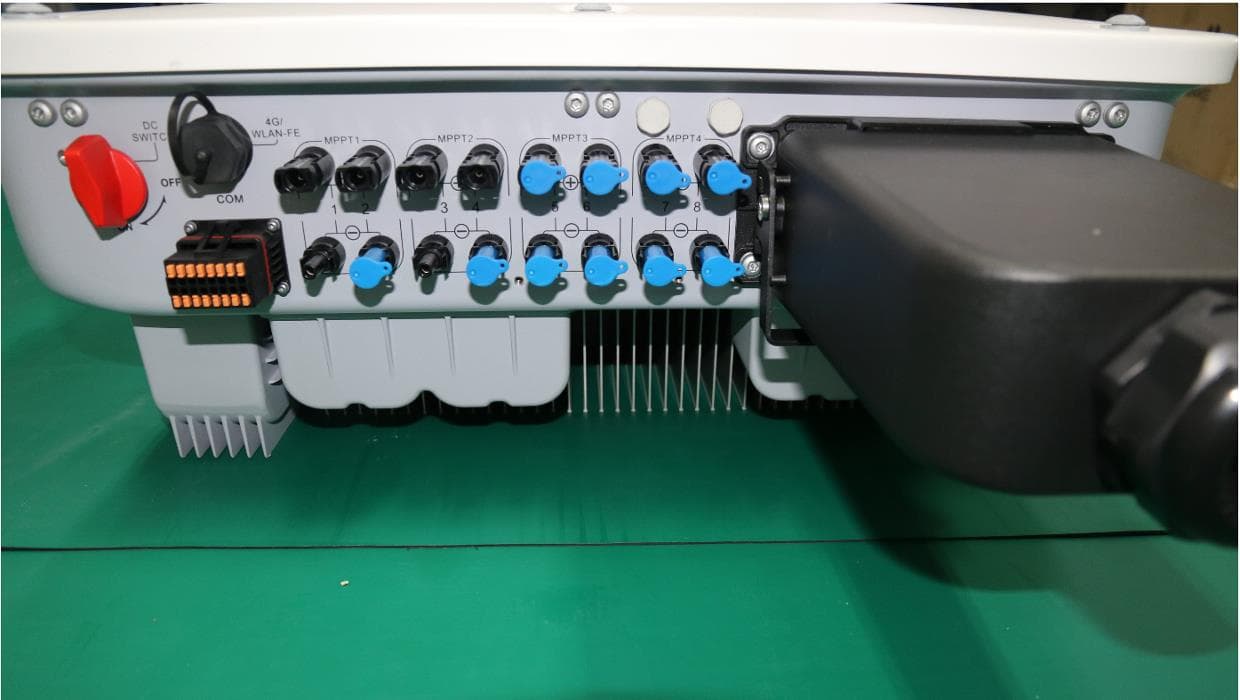
QISSUN2000
Jun 27, 2021Solar Inverter
Equipment Class
DTS - Digital Transmission System
QISCP81-1
Oct 22, 2020Watch Wireless Charger
Equipment Class
DCD - Part 15 Low Power Transmitter Below 1705 kHz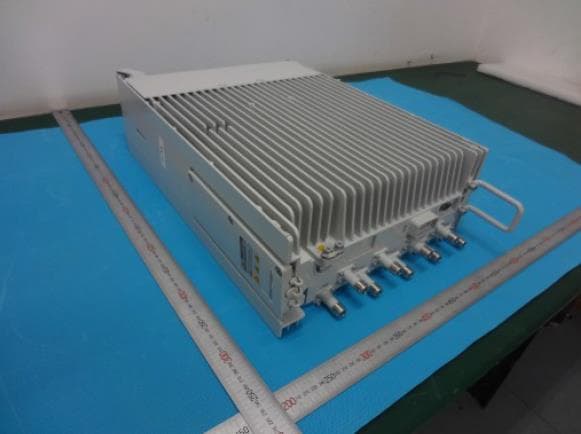
QISRRU3278
Sep 02, 2020Remote Radio Unit
Equipment Class
CBD - Citizens Band Category A and B Devices
QISR2561
Jul 11, 2020Indoor Router
Equipment Class
DTS - Digital Transmission System
QISSMARTLOGGER310
Mar 23, 2020Solar Smart Monitor & Data Logger
Equipment Class
DTS - Digital Transmission System